Thanks for checking out the LAFPI “tag team” blog, below, handed off each week from one interesting female playwright to another.
Who are they? Click Here

Thanks for checking out the LAFPI “tag team” blog, below, handed off each week from one interesting female playwright to another.
Who are they? Click Here
“PLEASE, PLEASE, PLEASE, PLEASE DON’T TELL ANYONE HOW THIS PLAY ENDS!” reads the page two playbill note of For Want of a Horse, staged by Atwater Village’s Echo Theater Company.
Here is where I would put a brisk, snappy summary of the play for you – an implied promise that I won’t be perfectly keeping, because I’m not quite sure how I would explain this world premiere. This, I believe, is a compliment to the audaciousness of playwright Olivia Dufault who, in her “darkly comic, deeply human exploration of love, desire and unconventional relationships,” brings to the stage something challenging and deeply, unusually original.
From the Echo’s website, continued: “Calvin is devoted to his wife, Bonnie. But if Calvin is going to move forward, he needs to open up their relationship to include his new romantic partner. One complication: that partner would be Q-Tip – and Q-Tip is a horse.”

Put simply and likely predictably, it’s a shocking play. It is a testament to the writing, direction, and performance of the play that its innumerable shocking moments never felt played for the sake of shock alone, and even a note as direct as the plea in the playbill felt entirely warranted. Leaving the show, I heard two audience members say to one another that they’d have so much to talk about on the car ride home. What other marker of success should we determine theatre by? I don’t know exactly how to explain this play to you, nor to myself, nor what it made me walk away thinking, exactly. But I did walk away asking myself a multitude of questions and for that, I am grateful.
Prominently among these questions – on my way out and still now, as I sit writing – was why does it matter that a trans woman wrote this? As evident later on in this piece, I was able to send questions to playwright Olivia Dufault following the performance. I’m not sure I could tell you why, but I didn’t choose to ask a single one about gender. Sitting in the audience watching, my own trans-ness surfaced and stayed top of mind, and I felt my own interpretation of the play deeply and monumentally ground itself in what I heard the show say about gender, from its first line and every moment forward. What did it change, to me, knowing that this show was written by someone who shares an aspect of this identity? Everything. Nothing. Or in truth, something, somewhere in the murky space in between quiet relation and direct confrontation and a long, long road adorned with familiar waypoints, headed into the unknown.

In addition to being trans, I’m aromantic- & asexual-spectrum – a set of identities that, upon their declaration, outline an even greater gulf between me and what/who this play works to portray. The profoundly distinct and distant experience I have with all types of romantic attraction thoroughly colored the type of attention I paid to this show, most explicably manifesting as what I think I’d term ‘heightened awareness’ of the questions it was asking in the moments and motions they were asked. An early line from Bonnie (played by Jenny Soo) about her reckoning with a difficult schoolchild echoed over and over again in my head: ‘as long as you’re not hurting anybody.’ As long as you’re not hurting anybody, as long as you’re not hurting anybody. You could take any word of that sentence and challenge it with this play. What is hurt, exactly? Who decides? How am I, the person sitting beneath the house lights, currently making that decision? “Anybody” accounts for who? What are the limits to empathy?
To dive further into the answers this play offers, and really, what challenges it strives to leave unanswered and openly on the table, I was able to send some questions to playwright Olivia Dufault who shared insight into the evolution, intention and staging of this world premiere.
Casey Fleming: Olivia, I read that your inspiration for this play came from your own reaction to an atypical interview (a New York magazine article entitled “What It’s Like to Date a Horse,” published in 2014). What, within your own experience reading and engaging with the article, made you feel that you HAD to write this play?

Olivia Dufault: When I first read the interview that inspired this play, my immediate response was shock, horror, and perverse amusement. But as I continued, I began to feel terrible pangs of empathy for everyone involved in the tragic situation – the husband, the wife, the horse. I found myself conflicted by these emotions; to what degree was empathy an appropriate response in this context? From this internal wrestling, this strange play emerged.
Casey: Walking out of the show, I heard a pair of audience members discussing how lively their conversation in the car on the way home would be. What two questions do you hope audience members walk away from this show asking themselves?
Olivia: What are the benefits and perils of empathy? And what exactly goes on in the head of a horse?
Casey: What did you learn about yourself over the course of working on this play?
Olivia: I have a high tolerance for discomforting topics. Audacious subject matter invites audacious collaborators. And that it’s shockingly easy to write from the point of view of a barnyard animal.
Casey: How does your idea of what a playwright should do or be responsible for doing – universally, at scale – inform your approach to writing For Want of a Horse?
Olivia: Honestly, I wrote this play ten years ago, and did so very much for myself. That’s always been my relationship with my work. This play was made to challenge and amuse me; I hope it does the same for others.
I was lucky enough to get to speak with another artist who was challenged and amused by For Want of a Horse – director Elana Luo. She spoke directly to her experience working on the play and the practical, emotional, and logistical learnings that accompanied.
Casey: In interpreting “challenge” to mean both content and technical ask, where were the areas of greatest challenge while directing this play? How did you approach and guide the cast/crew through them?

Elana Luo: The play moves quickly between scenes in different locations, so we had to figure out how to utilize and transform the space accordingly, or perhaps not. It was a feat of coordination between all departments – Alex Mollo’s set, Leah Morrison’s costumes, Matt Richter’s lights, Alysha Bermudez’s sounds, and the actors who had to wrangle it all. I’m very grateful to my cast and crew for their collaboration and ingenuity.
Casey: Over the course of working on For Want of a Horse, what part of your understanding of the show shifted the most between table read and opening night?
Elana: I got to understand each of the characters much more intimately. Steve [Steven Culp], Griffin [Kelly], Jenny [Soo] and Joey [Stromberg] all brought their own perspectives and truly embody their roles, which has added more layers and realism to Olivia’s already well-drawn characters.
Casey: How has For Want of a Horse changed your approach to directing or helped you grow?
Elana: I’ve never directed a horse before. Lots of poop and subsequent mucking thereof. It’s a very humbling experience for a big and important director such as myself.
Casey: If you were to break down your vision for the technical design of the show into a few key words, what would they be?
Elana: Beautiful. Beastly. Hopefully Disney doesn’t come after us.
“For Want of a Horse,” written by Olivia Dufault and directed by Echo associate artistic director Elana Luo, runs at the Atwater Village Theatre through May 25th. For more information and to purchase tickets, call (747) 350-8066 or go to EchoTheaterCompany.com.
I am writing this at 3:11 a.m. on Sunday night/Monday morning. I just got home after spending the last 48 hours+ participating in the LA Immersive Invitational, co-presented by After Hours Theatre Company and The Immersive Experience Institute. It’s a 48-hour theater “competition” where immersive theater companies are tasked with creating a new 10-minute piece over a weekend. I led the Rogue Artists Ensemble team, and it was the first time I’ve been able to participate myself, even though Rogue has been involved as a company for a couple rounds.
The general breakdown of the day is not unlike your typical 24-hour or 48-hour theater festival. It generally looked like:
Unlike a typical 10-minute festival where you might get the play performed 1-3 times, we performed ours…25 times.
There’s a brilliance in being able to create something and not have the luxury to be burdened with a desire for perfection. To let a project find itself in repetition. And to not assume this HAS to be a bigger, fancier project down the line.
I find myself getting stuck in cycles of production — I seldom write without an agenda and expectation. Free writes and journaling spark immediate irritation for me (even though I understand the WHY of it all). But this kind of cycle only serves to burn me out. It sucks the joy out of a process.

(Pictured above – the “backstage crew” i.e. me and John waiting with Carlos to hear what the audience decides, which triggers one of three endings.)
This weekend was a joyful process. Did we hit some snags and clashes? Yeah. Was it a perfect show? No. Did we create the seeds of something that might turn into a bigger THING? Maybe.
But most importantly, it made me remember how fun all of this is. And somehow in the big scheme of trying to have a “career” I’ve gotten in the loop of constant production and have forgotten how to play.
Sometimes forcing ourselves to play, to not be precious, to let your collaborators in, to be okay with not knowing all the answers…that’s the way to break out of your patterns.
Fittingly, the play was about folks who try to break a man out of a time loop he’s stuck in. We made three different endings that the audience helped choose–their actions in the story had three different outcomes. One progressive. One tragic. One psychedelic.
But every ending can also be a beginning. And every writing/creation exercise strengthens the muscles.
So, do you have permission to come out to play?
Think about that while I take a week-long nap.
by Cynthia Wands

A footprint in the sand along Moonstone Beach near Cambria that I found last summer.
A year or so ago I lost something – and I keep looking for it.
When he was making his glass art pieces, Eric made me a small ruby red glass heart, embellished with a gold filigree. I loved it, and kept it in a small crystal dish on our bedside table. After he died, I would look for it, pick it up, watch it glimmer in the light, and then return it to the same crystal dish. And one day it was gone. I was stunned. I couldn’t remember the last time I’d seen it. I live alone, with occasional company, but no one knows of this particular object. I’ve looked everywhere for it.
It’s been over a year and I keep looking for this red heart. I’ve looked behind furniture and in drawers, on shelves, in a box of keepsake mementos, and on top of the refrigerator. It’s gone. But I keep looking.
A few years ago I lost a notebook I kept at home for a writing project – I used it for spontaneous scribbles I wanted to corral together for a new script. And it too, suddenly went missing. A small black notebook, something I used frequently, and it just vanished. I have no idea where it is. I’ve looked at all the usual suspects, the desk, the office, the bookshelves, also the top of the refrigerator. It’s still missing.
This spring I decided to investigate this idea of the Disappearing Objects Phenomenon (DOP) and the idea of “jottles”. This is the in-explicable vanishing and sometimes unexpected reappearance of items. There’s some humor in this subject: ghosts, cats with extraordinary powers, a glitch in the matrix. And there are some interesting stories. I especially love the idea of items that unaccountably just appear again. Rings, keys, a beloved plastic cup. They just show up right where they were lost.

The research on “jottles” led me to other authors and research I knew nothing about. So I did find something new in all of this.
There are groups online that pursue the attending ideas around these “in-explicable” disappearances: worm holes of time, multidimensional beings, vibrations of “fae energy” and parallel realities where the lost objects gather together in the matrix storage room.
There are also discussions about behavior with an absent minded focus given stress, medication, aging or that second glass of wine. I’m interested in all of that. But I’m still looking for that glass heart. And that black notebook.
And I especially do love those stories of things that are suddenly “found”. I’m reminded of the story of my mother’s ashes. When she died after a long battle with cancer, she left conflicting instructions on where she wanted her ashes scattered. It was decided that a small group of family would sprinkle her ashes in the Spokane River, which was roaring along with record levels from the recent snow melt. We mixed rose petals with her ashes, gathered by the river banks, and scattered them in the furious water. We watched the ashes and the rose petals disappear. It was a strange and powerful reminder of loss.
Years passed. When my grandmother died, my sister Susan and I went to her funeral in Upstate New York. My grandmother had a poignant service at the small countryside church, with a beautiful white coffin covered with roses. She was buried in a small private cemetery, surrounded by the graves of our grandfather and other relatives. I hadn’t been in that cemetery in many years and as we walked over to the open grave for our grandmother, we stopped and stared at a new graveside marker.

In loving memory. Joell Dolan Wands. 1933-1997. My mother’s name appeared.
I flashed back to the day we tossed my mothers ashes in that roiling water, and for a moment, I wondered if that really happened. Because my mother’s name was now on this marker in this private cemetery. For just a moment I hung between the reality that I knew and what I was seeing. Susan squeezed my hand, I think mostly so I wouldn’t yell something, and we stumbled along to the rest of the graveside service for my grandmother. We found out later that my grandmother was so furious that my mother wasn’t buried in the private family cemetery that she put together a graveside marker for my mother and had it installed there, because it was the right thing to do. She didn’t want to tell us about it, because, well, that’s the way my grandmother wanted it done. That is some fierce “fae energy” from my grandmother. And really, surprisingly, it was lovely to find my mother’s name again.
This assignment of looking for something, paying attention, trying to make sense of loss – is very much akin to my life journey right now. This morning I gathered a bowl of rose petals from the garden and was reminded of that day by the river, where we tossed my mother’s ashes into a furious river, accompanied by a scattering of rose petals.
And then I laughed when I remembered that day at the cemetery, and the “found” marker for my mother’s name. Joell Dolan Wands.

April rose petals, now ready for the next transformation.

There is now a bird feeder outside of my kitchen window. Every morning I refill it with spicy birdseed. This was supposed to prevent the squirrels from eating it, but in fact, they sit on a branch just below the feeder and eat like they’re at a picnic table (I should have known Los Angeles squirrels would be just fine with spicy food, but I digress). It’s been a joyful moment each day to watch the birds appear in the feeder. Most of the birds share the space and food, though the lone scrub jay who comes by once a day prefers a solo dining experience. There is one type of bird who visits that always captures my attention.
I have always loved spotting the lesser goldfinch on walks around my neighborhood. This tiny little resident pompom of a bird has a nearly fluorescent yellow belly, and the males wear a little black cap of feathers. They are always a welcome sight on an overcast day in the winter, a reminder of color in the life that sits dormant around us awaiting spring.
Within a week of setting up the feeder, I spotted the first lesser goldfinch. Then another. Now there are six at a time who visit, emptying the feeder so often that I wonder if they’ve taken up permanent residence there. The first time I sat outside near the feeder they chirped at each other, at me, but didn’t venture closer. The second time they hopped along the branches, observing the distance. The third time, they came straight to the feeder, and I was able to watch them up close as they ate. The other birds remain somewhere nearby, hopping from branch to branch, quietly waiting for me to leave. But the brave little lesser goldfinch does not fear me.
“Perhaps they just aren’t smart enough to fear you,” a recent visitor said. I disagree. Perhaps instead it is that when you’re so small, you have no choice but to be brave, over and over in the world around you.
I won’t say much about the world around us beyond this: the way life operates now is a nonstop churning of opinions, thoughts, news, cycle after cycle of emotional overload that almost feels like it is purposely meant to break and distract. The path of survival I walk is one where I observe the birds outside my window. The choice I will make when I feel small will be that of the brave lesser goldfinch. Over and over. Nature is where I put my attention. It always has the lesson.
I was born and raised in the military. My father was deployed on an aircraft carrier off the coast of Okinawa when I was born at Tripler Army Hospital on the outskirts of Honolulu. This was during the Korean War. He served thirty years in the Navy, which means I grew up inside the military complex.
It is different to be raised in the military instead of being raised in the civilian world. As I write this, I see how I really can’t explain the difference because I do not have a reference to what it means to grow up outside of the military. Perhaps this is one of the reasons I thought of the playwriting project Military Family Staged Readings—to better understand the bridge between the two worlds.
There is also a difference between those who wear the uniform and those who wait for the return of the deployed. Each experiences the military in a different way, and hard as we try, there remains a gap of understanding, of experiences. My father was deployed many times—leaving on a big ship and returning six months or a year later. When he left I was one way, and when he returned I was a different person. We both changed during his deployment and it took time to reconnect and establish our relationship as father and daughter.
You may wonder why I begin this blog post about a child whose father deploys to a far away country and what that has to do with playwriting and the theater. Most people in our society do not understand what it means to be a spouse, child, mother or father of those who wear the uniform.

Since 2010, I have worked with Veterans helping them tell their stories through poetry, prose, and playwriting through the organization Returning Soldiers Speak. As rewarding and meaningful and important as this work has been, I yearned to do something different. I wanted to honor the family members of the military.
I guess you could say that I wanted to honor my mother who was a military wife for thirty years. And my sisters who moved from place to place with each new set of orders. And that little girl who waited for her father’s return. So, I wrote a proposal of a playwriting project for Veterans and family members—playwriting workshops that would culminate in a series of staged readings for the public—and submitted it to the City of Los Angeles Department of Cultural Affairs. We were awarded the grant (that is, a matching grant) and began the playwriting workshops last fall.
The interview process was challenging because each person was wonderful and full of potential and passion, but due to the constraints of our budget, we couldn’t accept all of them.
Our playwrights are Benjamin Fortier, a Marine Corps Veteran who was in Fallujah in 2006; Gregory Hillman, a Marine Corps Veteran who was deployed to Afghanistan; Jeffrey Webster, a Coast Guard Veteran who does ceremonies for Veterans in Hospice; Bryan Caldwell, a grandson of a Navy Captain; Denah Angel, a daughter whose father served in the Air Force during the Vietnam War; and Liisa Rose, a wife whose husband was an Air Force Colonel who served for almost twenty-nine years.
Some live in Los Angeles, others live in various parts of the country. The challenge has been how to bring all of us together—and so enter Zoom. It amazes me how intimate the workshops have been using this virtual platform.

One Saturday morning during our Zoom playwriting workshop, we were focusing on Liisa Rose’s play. Her play asks the question: Is the current state of the country worth giving one’s life for? This is a provocative question to ask at any time, but to ask this question during these turbulent times is daring, brave, and important.
Support and Defend is the title of Liisa’s play and the main character faces the challenges of grieving the death of her husband (a character who died while deployed to Afghanistan) and raising her two almost-adult children. Much of Liisa’s play draws upon her own experiences in the military (but thank goodness she and her husband are living happily in Arizona).
At one point in our conversation, Liisa began telling us about a very personal experience that happened when her husband returned home from yet another deployment. I asked her if she had written about that and she said no. I suggested she write a monologue for the main character. She did. And then she wrote a scene based on their experience. It is one of the most powerful things I have ever heard or read.
She debated whether the scene belonged in the play, and if it did, where in the play’s structure would the scene reveal what it needs to reveal? She also wondered what her husband would say if she told him that she wanted to write this scene. He told her that would be okay. And ultimately, we decided that the play needs it.
It has been my honor to work with Liisa; she is a good playwright and has written an important play. The question she poses about weighing the current state of one’s country drives the story forward, and invites us to look with new awareness and search for an answer. After each reading, the playwright and the audience will engage in dialogue. I am curious what shape the dialogue will take after hearing Support and Defend.

Our other wonderful female playwright is Denah Angel Shenkman. I know Denah from Ensemble Studio Theatre/LA where we have worked together for many projects—I as a playwright and Denah as an actor.
A while ago, Denah told me the story about the Greek side of her family. During World War Two, the family’s house was taken over by the Nazis and her two aunts had to fend for themselves. They eventually escaped and found their way to America and joined their father. Theirs was complicated journey and a fascinating journey. I knew this project would be an opportunity for Denah to begin writing about her ancestors.
In writing her play, Denah has drawn upon her family’s story, and at the same time embraced the creative process of letting the story and the characters define the play. She has known all along what story she wants to tell, and it has been exciting to watch her take the leap into an unknown place and find the elements and aspects of the characters and their journeys.
One of the first times (if not the first time) Denah, Jim Lunsford (our wonderful dramaturge) and I met, she said that she wanted to write a love story. She wanted to show the complexities of what it means to live during war and to discover love in that harsh and brutal world. She began with three characters, added another character, and then another character to deepen and strengthen the theme, conflict, story and plot. She has drawn upon her Greek heritage in subtle and not-so-subtle ways that add spice and flavor, history and authenticity to the play. How she weaves Greek mythology throughout the characters’ lives—their relationships and their dialogue—makes sense in this world of her creation, and invites us to envision what it means to live in a place rooted in mythology.
We might inquire: How does ancient mythology speak to me in the 21st century? What can I learn? How might I use myth to create myth? What can I learn from the historical context of the play that will serve me during these turbulent times? For me to ask such questions means the playwright has done the work and written a play of meaning and authenticity. I am excited to bear witness to the dialogue between the playwright and the audience after the reading of An Era.
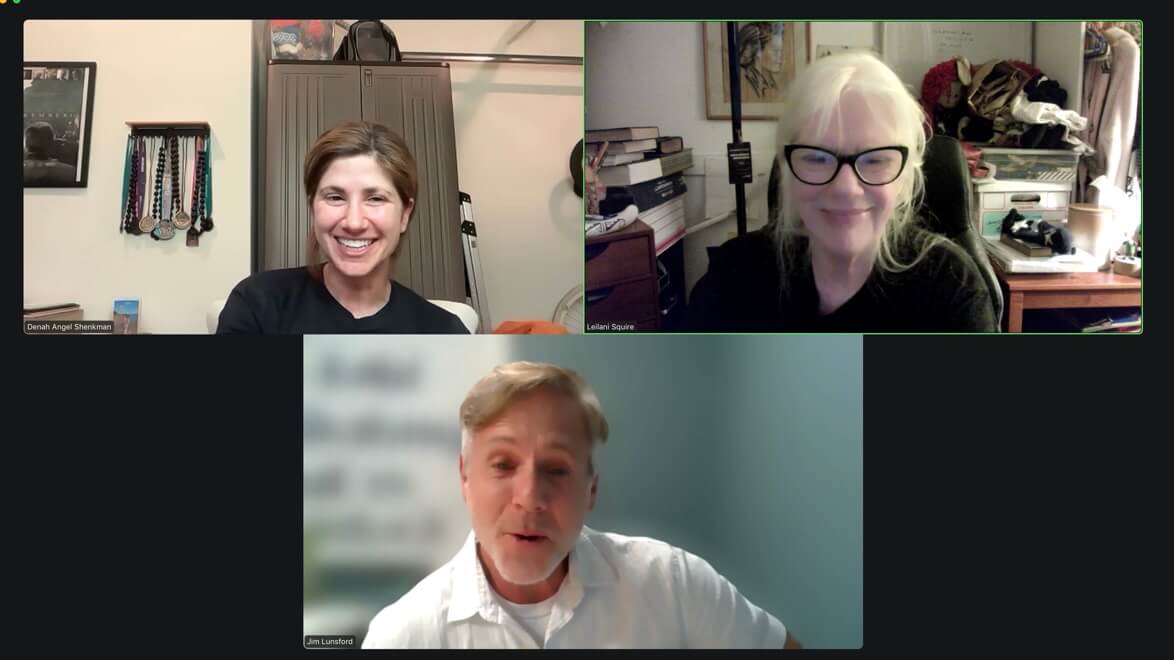
I must give a shout out to Jim Lunsford, our incredible dramaturge. I couldn’t have done this project without him. He understands theater in a way that I wish I did. He sees through to the essences of structure in a way that I wish I did. He envisions the whole picture, while I see the specifics—we make a wonderful team.
I am directing An Era and honored and excited to be doing so. Keith Szarabajka and Joe Garcia will direct readings as well.
The staged reading series begins with Denah Angel Shenkman’s An Era on March 25 and closes with Liisa Rose’s Support and Defend on April 29.

There are four other staged readings in the series that will also be awesome:
I hope you join us for these wonderful plays, engage in the dialogue after the reading,and enjoy the camaraderie of community.
Military Family Staged Readings take place March 25 – April 29, Wednesdays at 7:30pm, followed by dialogues between the playwrights and audiences. The readings take place at Sawyer’s Playhouse, 11031 Camarillo Street in North Hollywood, CA. Donations will be gratefully accepted. For more info, visit returningsoldiersspeak.org/military-family-staged-readings-project

It is little known historical fact that in 1932, the Communist Party of the USA spearheaded a film project highlighting the plight of Black Americans that was fully paid for and sponsored by Joseph Stalin. Over a dozen Black Americans were recruited from Harlem to travel to the Soviet Union for filming and production, and Langston Hughes was hired to revise the screenplay in order to make the story and its characters more realistic and responsive to the Black American experience. At the time, James Ford, a Black Tennesseean who became a prominent civil rights leader, was the Vice-Presidential candidate on the American Communist Party’s presidential ticket. It was Ford who convinced Stalin to fund the film as a way to garner support for the Communist Party more globally. The film was absolutely a propagandist project against American capitalism, but for many of the Black actors involved, it was the first time they felt seen, heard, and respected as artists. Red Harlem is a play that imagines the lives of four of these artists as they embark upon a journey from the Cotton Club of Harlem to the vibrant nightclub scene in Berlin to the grandeur of Moscow where they are treated for the first time as first-class citizens, free from the unrelenting racism they’ve known their whole lives in America.
Red Harlem is having its World Premiere with the Company of Angels Theater in Los Angeles. For me, watching the play in full production was particularly gratifying as I had the pleasure of participating in the Company of Angels’ Professional Playwrights’ Group with the playwright Kimba Henderson back in 2021. At the time, Red Harlem was in its very early development; Kimba was still discovering the character arcs and their relationships to one another. To see the fully fleshed camaraderie between the members of this tight-knit group, despite their conflicting needs, desires, and fears, was incredibly satisfying and moving.

The world of the play is big and all-encompassing in terms of the diversity of characters and the depth of human experience in the 1930s. What makes it so dynamic is that it is transnational, transpolitical, and transracial. All the borders are blurred as Kimba resists the urge to put her characters into their own separate boxes. Here there are no clean-cut dichotomies of good vs. evil, moral vs. immoral, or villains vs. heroes. Lenore, a staunch Communist, falls for David, a Jewish man from Brooklyn whom Lenore believes to be half-black. Shifty is a member of the working class, a person with no party affiliation, but one with a keen eye for hustle, and an eventual soft spot for Velma, the cross-dressing nightclub manager in Berlin. Selena and Will are a couple who love and support each other’s aspirations but are susceptible to competition and jealousy as the power between them shifts once in the Soviet Union. Misha, the general who is appointed handler to the actors, is providing cover for the Communist Party whilst growing his empathy for the eclectic group under his charge. And finally, there’s Colonel Cooper, factually the world-renowned engineer who constructed the Dnieper Dam for the Soviets and brought electricity to millions, who also happens to run into this film production and plays an influential role in shutting it down. At every turn, the characters’ own core beliefs are challenged through their encounters in a new land, across racial and cultural borders.


One of the more interesting aspects of the play for me is how Kimba addresses colorism. Selena, a regular dancer at the Cotton Club, is employable because of her light skin tone, while Lenore knows all too well the sting of rejection simply because of her darker complexion. In the Soviet Union, this color hierarchy is switched, and Lenore feels like her talent can finally shine. Simultaneously, Lenore falls for David but feels betrayed when she learns that he is Jewish and not a light skinned Black person as he’d allowed her to believe. All the nuanced assumptions around race—and what it means to be Black in America vs. elsewhere—reminded me of how much race has been socially constructed for the purpose of building an American empire.
In talking with Kimba, we discuss the significance of historical fiction and the import of Red Harlem today. Kimba says, “I don’t want to write something if I don’t feel it’s relevant” and how “the play kept getting more and more relevant.” She points out, by way of example, how the Brownshirts were like the Proud Boys, and how the Nazi rhetoric mirrors much of what we hear from our polarizing President. And too, the fight for world dominance and ideological superiority, at the expense of masses of civilian populations, is age-old and still at play in a war that is happening right now as I write this.

Further, I always like to ask other writers about their process. It’s out of my personal desire to glean their magic tricks: How did they do it? What’s in the secret sauce? For Kimba, she quips, “flow writing.” When she worked with the Robey Theatre Company, she had a mentor encourage her to place her characters in a place they’d never normally be, and to explore through freewriting, why they happened to be there and how they dealt with the discomfort. Kimba frequently employs What-if writing exercises like this, particularly in the world-building phase of her development. She says that she has pages and pages of such kind of writing on each of her characters, scribblings that never make it to the final play. She knows them and their pasts so well that when she’s asked any dramaturgical question, she can readily imagine how a character might respond. In one of her best examples, Kimba describes a late addition to play, a scene where David writes a heartfelt letter to Selena apologizing for withholding the truth about his being Jewish. In it, he tries to explain his philosophy on life, recounting a memory of his father standing outside Small’s Paradise, a Harlem Jazz club, tapping his foot and enjoying the music but never allowing himself entry. David never wanted to live his life like his father, standing on the perimeter of life’s joy.
The play is directed by Kimba’s longtime friend and artistic collaborator, Bernadette Speakes. Kimba credits Speakes for her ability to take viewers from setting to setting, across the globe with a small moving set of screens, some well curated projections, and a few stage blocks. Even in the 99-seater space, the play manages to pull off a kind of magical splendor. There are big musical and dance numbers with choreography and costuming befitting of professional entertainers and denizens of nightlife in the 1930s. The play is, after all, about performers and their passion for their art at all costs. Kimba says, “you can’t own people’s artistry. They own that. That is theirs,” and that this play, ultimately, is about these actors, each in their own way, “taking ownership of their artistry.” That message carries resonance. At all times, both then and now, artists like myself and hopefully you the reader, through whatever sacrifices and concessions we have made, have been staking a claim to our creative lives.
This is a story that needs to be told, and I hope that it gets told many times over—on stages, on small and big screens, to classrooms full of historians, to world leaders who claim historical amnesia, and to all the artists of color who are still waiting for permission.
The World Premiere of Red Harlem at Company of Angels ran February 14 – March 15. Go Here for more information about the production.
Do not believe that he who seeks to comfort you lives untroubled among the simple and quiet words that sometimes do you good. His life has much difficulty and sadness… Were it otherwise he would never have been able to find those words. ~ Rainer Maria Rilke (from Letters to a Young Poet)
Has it really been a week now since the President of the United States, Donald Trump, announced “Epic Fury” on Iran? The night before that, Friday, 02/27/2026, the LAFPI Blog editor sent me the reminder that it’s my week to blog. Meanwhile, it’s also Lenten season, and Ramadan at the same time. I decided I will not be blogging about any leading headlines. With the weight of world events, I’m feeling quite tired and sad in every sense of the word.
Right now, I choose to just attend to what’s necessary. Cut back on social media, cut back on texting, cut back in general on unnecessary noise. The simplicity of putting one foot in front of the other, rather than one word after another has been my steady gait. I mean this literally. I’ve just been hiking in the nearby park and criss-crossing the trails. Words escape me. I have images juxtaposed upon another.
I am deadheading the faded blossoms and the accumulation of non-sense. This spring cleaning has awakened my consciousness of the joy I’ve been robbing myself of. I miss writing poetry. There was a time that writing a poem came to me so innocently pure. The high states of being in-love prompted expression of the bursting ecstasy. The “mean reds” and deep blues flowed like spilt fountain pen ink all over the page and onto the table; the stain taking shape, come what may.
The theme of yesterday’s homily was the importance of faithfulness and accountability for what has been entrusted to us from the divine. Everyone has a talent, and yes, some are gifted with more than one, hence more is expected from those with more talents to offer. I felt the priest was speaking directly to me for not being faithful and accountable for my writing. It’s been on my mind a lot, for quite sometime.
A couple of weeks ago, I had the inkling for “diving into the wreck” of poetry. I carried around a book of poems, but not really burying myself into it. Then recently, I had thirty minutes to spare before the 5:30 PM mass, and I ordered steamed dumplings at Northern Cafe Dumpling House. While the order was being prepared, I crossed the Figueroa Street to peruse the books at the Goodwill, and I quickly found a paperback of a collection of essays and poems by Adrienne Rich. I felt fortuitous, and guided to be on the right track. I’ve been absorbing her works I hadn’t read before.
Tonight, walking under the canvas of stars and moon, in its waning gibbous phase, I recalled a bible book from the old days at The Imagined Life acting studio with Diane Castle. One of the required reading was “Letters to a Young Poet” by Rainer Maria Rilke. When I got home, I quickly found my copy. When I opened the book, a couple of pictures fell out. They were of my beloved Bruno Herve Commereuc. One picture shows Bruno, in front of a stove, holding a sauté pan with one hand while the other is spooning something into the pan. The other picture shows him relaxed and thoughtful, on a chair, surprisingly holding a Coca Cola can (and not a glass of wine). I remember he told me this was the upstairs of Angelique Cafe, his first restaurant in Los Angeles. During this time in his life he looks like a young poet. There was a sweet mien in his gaze and deep passion in the set of his jaws.
The pictures were inserted at the end of “Eight”, the eighth letter of Rilke to Kappus, written on August 12th, 1904. This particular letter addresses the sadness that Kappus revealed to Rilke in a prior letter.
I believe that almost all our sadness are moments of tension that we find paralyzing because we no longer hear our surprised feelings living…
And this is why it is so important to be lonely and attentive when one is sad: because the apparently uneventful and stark moment at which our future sets foot in us is so much closer to life than the other noisy and fortuitous point of time at which it happens to us as if from outside. The more still, more patient and more open we are when we are sad, so much the deeper and so much more unswervingly does the new go into us…
At 2 o’clock tonight, I will adjust my wristwatch one hour ahead to “spring” forward. This perhaps is a jump start on getting out of the quagmire that I feel anxious to get out of so I can get on with life. But, I know it’s not the way through. I need to be more still, and more patient and more open to this sadness and let it run through me, without hanging on to anything.
by Constance Jaquay
Love Is & Will Always Be
In times when systems fracture, and values feel unstable, Love rises to be the only organic matter that can’t be tainted.
1.
On the deathbed of her mother, she sits. In over forty years, it’s the first time they’ve held hands. They cling to one another as though their bodies can reverse time.
He holds her face in the palm of his hands. He lifts her head towards him and whispers in her ear: I love you forever. Her left hand covers his right hand // she replies, pressing her face deeper into his palm.
2.
In between uterine contractions and cervical dilations, she pushes life from her body. Her mind traces and tracks what it took to get to this moment. She remembers the first time she met her husband. How young/bold they were. She’d never imagine thirteen years would go by_together. A nurse hands her a crying baby; as she holds her little girl in her arms, her heart morphs // she begins to realize, as her mother was, that she is now a mother too.
3.
It felt as though she’d been crying for years. Weeks turned into months, and it seems she has only just begun to find her rhythm again. He was her first gift. They had grown up together. In many ways, it felt as though her dog Dingus was her soul manifested as an animal. For months, he seemed to have stopped playing, as though he was living only to survive. It was time she realized she must let him go. That his pain wasnot her pain, and it wasn’t fair to keep him alive. She felt as though shed been kicked in the gut over and over again. She never imagined she would be burying her first baby.
As life does, it reminds us of the fragility of what it means to be human.
In moments of passing and in moments of new life, in holding on and in letting go, one thing remains untouched:
Death comes for us all. What lingers and sticks is what the heart held. What endures is that we dared to love, long after one is gone.
Love Is & Will Always Be

by Kitty Felde
In the latest iteration of Star Trek, “Star Fleet Academy,” the loveable 900 year old holographic doctor played by actor Robert Picardo has returned and his love of opera has spilled out across the universe. It’s great fun, but can’t compete with the full-length Star Trek opera I was lucky enough to witness earlier this month.
The Pacific Opera Project, a plucky little company founded in 2011 by Josh Shaw, has a mission as clear as boldly going where no theatre company has gone before: “To reimagine opera as an affordable adventure, by making unforgettable, entertaining performances accessible for all.” And indeed, their production of Mozart’s “Abduction from the Seraglio” fulfilled that mission. And it didn’t take five years.
The plot of the original opera is pretty dumb: the hero, a Spanish nobleman, is out to rescue his love interest from a Turkish harem. In the POP revival of its 2015 production, the Turkish bad guys have been transformed into Klingons (Andrew Potter, with a voice as deep as deep space who must be at least seven feet tall!) and our Spanish nobleman hero has been reborn as Captain James T. Belmonte (played by Brian Cheney) who channels his best WIlliam Shatner, complete with manly poses and staccato dialogue. The women, alas, are stuck in “Barbarella” era outfits – at least until the plucky Lt. Uhuru knockoff (Shawnette Sulker) changes into her velour mini skirted uniform. The libretto was written by Josh and Kelsey Shaw and conducted by Caleb Glickman.

The audience could be described as opera fans at a Star Trek convention. There was even an award for the best costume.
There were tribbles, sword fights (using the curved edge Klingon bat’leth) and even a hilarious boulder tossing tussle with the giant lizard Gorn – one of the dumbest scenes from the original Star Trek series.
I confess: I am not a huge opera fan. And I’ve seen so much bad theatre in my time that I was prepared for the worst.
It was wonderful. THIS was theatre at its finest – smart, silly, touching, terrific performances by the leads sprinkled with scene stealing chorus members from Occidental College. It reminded me of the glory days of the 1980’s when small theatres popped up all over Los Angeles, the days when even “Time” magazine named L.A. the genesis of innovative theatre. Sigh.
The run has ended. Alas. But you can still see the production on YouTube. No pointy ears required.
Kitty Felde is the author of The Fina Mendoza Mysteries series of books and podcasts, a middle grade book series designed to introduce civics to kids.

This last week was a weird one. My novella, Krackle’s Last Movie, was officially published with an amazing small press, Split/Lip Press. What this meant was I found myself in a zoom Craft Talk with the Writer’s Center, which I’d stressed about for a week and wrote out four pages of notes for myself. Because I don’t trust myself to know my own work or process just off the top of my head.
Probably the most truthful thing that came out of it was something I hadn’t written down. They asked at what point in the writing process do I start thinking about “craft”. Is it always part of the process or does it come in later?
And my answer was that I’m always aware of it. But I’ve had to turn off the judgement. Let there be ugly sentences and misshapen scenes. And then when I go back…I look at craft in layers.
I do a layer of character. A layer of detail. A layer of structure. The big layers first, which usually means structural stuff – moving scenes around, etc. Then character arcs. Then details. And on and on. I know for myself, if I look at everything I need to do, I freeze up and can’t move forward. Same if I don’t let go of the judgement when first writing — I freeze up and nothing gets written.
I don’t think this is revolutionary. But as the talk went on, I found myself returning to the idea of layers. Every scene is layered. Every detail that’s chosen has layers. Structure has layers. You drill down multiple layers within every moment of a piece of writing (or insert other important thing here.)
I felt like some kind of echo chamber of my own making, every time I said the word “layer.” But I don’t think I’d ever articulated it like that before. When you’re forced to articulate what you do…you suddenly become aware of the hidden mechanisms that have been built below the surface.
There’s probably a metaphor in there somewhere for the times we’re in.
In any case, if you’re overwhelmed right, whether that’s in your writing or with the world at large, try piecing out the layers of a thing rather than hitting everything all at once.
This meme is maybe the best way to summarize it:


