Category Archives: Women

The FPI Files: Playwright Leah Nanako Winkler & Director Deena Selenow

For the past few years, LA FPI has been very much into matchmaking: introducing female playwrights to female directors with an eye on future collaborations. So when East West Players (EWP) invited us to be their Community Partner for the West Coast Premiere of Leah Nanako Winkler’s Kentucky, directed by Deena Selenow, we immediately said, “Hell yes!” And took the opportunity to ask this exciting creative team a few questions.

LA FPI: What brought the two of you together, initially?

leah-nanako-winkler
Leah Nanako Winkler

Leah Nanako Winkler: Last summer, I was fortunate enough to work with Artists at Play (AAP), an amazing LA-based theatre company that did a developmental workshop of my play, Two Mile Hollow. They immediately suggested working with Deena because they were confident she’d nail the humor of the piece while maintaining the seriousness of the issues regarding race—and even more so, class—that lurks beneath the surface of the play. I didn’t think twice when they suggested her because: A) I trust everything AAP says since they’re some of the smartest people I’ve ever met; and B) I’ve only heard great things about Deena. I’ve admired her from afar as a fellow mixed-race theater artist.

Deena Selenow: I knew some of the AAP folks from around town, so when they invited me to direct the reading I—of course—said yes. Then I read the script and fell in love. Leah’s writing is so blunt and funny and nuanced and moving. She shifts tone like an acrobat, and it’s so clear that she has fun while she writes. Leah, Julia Cho (AAP producer), and I had a great collaboration leading up to Two Mile Hollow.

LA FPI: Were you familiar with East West Players before this production?

Leah: I’ve known about, admired, and wanted to work with EWP for quite some time. I’ve been immersed and singularly focused in the past decade doing plays in NYC, but it wasn’t until last year that my dream came true and Kentucky was fully produced Off-Broadway. I kind of thought—well, what now? What will happen to me when this is over? So imagine my surprise when EWP Artistic Director Snehal Desai called me to tell me Kentucky was going to be included in East West Players’ 51st Anniversary season. I feel so empowered as a Japanese American artist working with a diverse creative team. I definitely feel like I’ve won the lottery.

dselenow_photo
Deena Selenow, photo by Vincent Richards.

Deena: Snehal Desai and I met through the TCG SPARK Leadership Program, which is a branch of Theatre Communications Group’s Equity, Diversity & Inclusion Institute. At that time, he was the Artistic Associate and Literary Manager at EWP (he’s made quite a climb in a short amount of time!). SPARK is a cohort of ten, so we all became close very quickly. Snehal and I are the only two based in LA, so we see each other quite a bit. I think I had seen one show at EWP when I was in grad school, and now I see pretty much everything they do. EWP is a vital American theater, and Snehal is an incredible leader. I’ve loved getting to know Snehal in this creative capacity. Tim Dang has left EWP in good hands.

LA FPI: Leah–what was it about Deena that gave you confidence in her? And Deena–what was it about Leah’s play that spoke to you?

Leah: Deena and I both want the same thing: for the play to be the best it can be. With her, I know that nothing is about ego but for the greater good of the piece. Even in our disagreements or points of confusion, we’re both straightforward and come to a conclusion without any passive aggressive weirdness, which is huge as playwright/director relationships can get complicated in that way fast.

Deena: Leah’s work in general is so very honest and the characters speak their minds. She writes realities in which people don’t self-censor and say what they mean. It’s hilarious and uncomfortable because it’s so familiar. Particular to Kentucky is remembering that moment in your life when you realized you can never go home again. That home moves, and the idea of home changes as you grow up and evolve. Family is complicated, and Leah doesn’t shy away from that.

LA FPI: When did it hit you that you two were a good fit, collaborating on Kentucky?

Leah: I think we had an initial phone call that was supposed to be an hour that turned into four. Our personalities definitely vibe, which is an important foundation. But we both worked actively together on a new nine-person adaptation [the NY production had a cast of 16] and figured out the doubling schemes together. I really felt connected in those moments.

Deena: I love working with Leah. I love how vulnerable she lets herself be in her writing and in the rehearsal room, and it encourages me to let my walls down as well. We worked really closely during pre-production. We took our time, imagined different scenarios, and listened to each other. Leah trusts me, and I can feel it, which gives me confidence. She gives me room to experiment but also doesn’t hesitate to speak up and tell me when I’m off the mark, which I also appreciate.

LA FPI: Kentucky’s director for its Off-Broadway Premiere, Morgan Gould, was a woman, as well. What are your thoughts about what a woman director brings to a female playwright’s work?

Leah: While I know of and work with male directors that bust their ass on a daily basis and deserve every career success that they get, I know that female directors have to work twice as hard to be respected. As “emerging” playwrights, we’re sometimes told to “level up” to a director who’s more famous, and that’s often an older white dude. I think while this tactic is meant to “protect” the young playwright in many ways, it really screws over young female directors that often develop the script for years only to be fired when the show gets picked up.

Kentucky is a huge undertaking with multiple characters, 17 locations, three songs, and complex relationships that need to be dug into with precision, sympathy, and understanding. It takes a BEAST to direct this play. And both Morgan and Deena are BEASTS. It’s incredible and inspiring to watch strong women take total command of a room. They get shit done with the strength of ten thousand men.

Deena: Any time you work with someone who is “like” you in some way or another, there are certain nuances that don’t need discussion and are just inherently there. I work with a lot of women playwrights, but with men as well (albeit not as frequently). Differences are just as important as similarities. There are inequities in every inch of our society, so I work with people who share my core values, and we lift each other up.

ewp-kentucky-1
(L-R) Jacqueline Misaye as Sophie and Jessica Jade Andres as Hiro in East West Players’ West Coast premiere of Kentucky by Leah Nanako Winkler. Photo by Michael Lamont.

LA FPI: As women artists, telling a woman’s story, how has your experience been with East West Players–a company that embraces diversity and is presenting a femme-centered season?

Leah: I think “white girl” and “diversity” are often conflated, and I love that EWP is championing women of color. In addition, nobody is the “only one” here, and it’s a gift to be working with not only a cast, creative team, and crew that are diverse, but also producers, board members, and staff as well. I’ve never had that happen to me.

EWP lets us do our work while acting like it’s the most normal thing in the world. By doing that, they universalize our experiences. And you know what? Good. Because our stories ARE universal. We’ve been told that white is normal for so long, and it’s just not true. I love EWP because they acknowledge this naturally in their mission, but it’s still fun and it’s a safe space.

Deena: I’m thrilled that EWP chose to program a women-centered season. They really put their money where their mouth is when it comes to equity and inclusion. We all need to be allies to one another. EWP has a platform for visibility, and they are using it.

LA FPI: As theater artists, how important to you is forming ongoing relationships vs. finding the right person/project?

Leah: I’m still learning about this. I directed my own work for six years and just started working with other directors in the last four. I like working with a lot of different people just to test the waters, and get to know as many people as possible. I love collaborating and finding long term relationships with various people on projects that work for each partnership. Which for Deena and I, ended up being Kentucky.

Dena: Relationships are everything. Theater is a collaborative sport and finding your teammates is key. I’m so glad that Leah and I have found each other. I’m excited for our relationship to grow and to continue. I’ve been really lucky in my collaborations. The dynamic changes with each group of people and each project, and that’s part of the fun.

LA FPI: In seven words or less, what’s your advice to women artists about getting the most out of the collaborative process?

Leah: Communicate. Be assertive. Don’t forget the joy. (Or LADIES, DON’T BRING SNACKS OUT OF OBLIGATION.)

Deena: Listen. Trust your gut. Make a mess.

Kentucky plays through December 11, 2016 at East West Players’ David Henry Hwang Theater.Click Here for information and to purchase tickets.

Know a female or FPI-friendly theater, company or artist? Contact us at lafpi.updates@gmail.com & check out The FPI Files for more stories.

Want to hear from more women artists? Make a Tax-Deductible Donation to LA FPI!

Donate now!

Los Angeles Female Playwrights Initiative is a sponsored project of Fractured Atlas, a non‐profit arts service organization. Contributions for the charitable purposes of LA FPI must be made payable to “Fractured Atlas” only and are tax‐deductible to the extent permitted by law.

New on the LAFPI Podcast: “What She Said” – Alyson Mead with Deb Hiett

deb-heitt


Alyson Mead speaks with playwright Deb Hiett about development, trusting “the soup,” and the alternate universes of game shows in her new work The Super Variety Match Bonus Round, a Rogue Machine Theatre production currently playing at the Met Theatre in Hollywood

Listen In!


What conversations do you want to have? Send your suggestions for compelling female playwrights or theater artists working on LA stages to Alyson Mead at lafpi.podcast@gmail.com, then listen to “What She Said.”

Click Here for More LA FPI Podcasts

We’re Not Playing, and we want YOU to join us!

Last week a lot of us watched in horror as Donald Trump, a misogynistic, xenophobic, and wildly ignorant human (we think…) man, was elected to be President of these United States.

I’ve been spending a lot of time since then working through all my feelings on the subject, and I’ve managed to boil all my rage, disappointment, and shock into two major thinking points:  “We have to do better!” and “Fuck that guy!”

(Obviously the former is a more actionable frame of mind to be in, but I’d be lying if I said the latter thought didn’t help fuel my desire to follow through on the first)

So I’ve been doing a lot of writing… and not in the “Wow, I’m making some great art from this!” kind of writing (yet).  More like, “Umm, I think I’m writing a mission statement” kind of writing, and it’s based on the following:

We need to heal our divided nation and We need to make our objections to Trump’s dangerous policies heard.

I’m working on strategies for the first, but Little Black Dress INK already had a jump start on the second – and we’d like you to you to join us!

not-playing

Little Black Dress INK invites you to take action by participating in the 
We’re Not Playing initiative.  This initiative began as a way for us to support female voices who were speaking out on important issues through their work as playwrights – and now it’s time for these voices be heard!

Theatres and theatre practitioners across the nation are invited to hold readings of these plays, royalty free, Friday, January 20, 2017 – Inauguration Day.  The only caveat is that we ask any/all monies raised be donated to the ACLU, Planned Parenthood, and/or NRDC – organizations we believe will be integral to fighting the dangerous policies which the incoming administration intends to implement.

Little Black Dress INK will continue to post socially-conscious/politically-inspired plays between now and January for interested theaters to select from – or you can challenge your own circles of fabulous playwrights to write plays that inspire action.  Let’s just do something to help process the rising tides of panic gripping the nation.

Let us make our objections loud and clear, and let us put our humanity center stage on January 20th, 2017.

We can be better.  Let’s be better.  Let’s invite our audiences to be better with us.

Want to get involved?  Sign our pledge at www.LittleBlackDressINK.org  Then start reading and selecting plays from those we’ve published, or invite other awesome female playwrights in your area to contribute work!

And if you’re a female playwright who wants to contribute short plays or monologues to the initiative, please send them, along with a photo and brief paragraph explaining what inspired you to write the piece to Submissions@LittleBlackDressINK.org – make sure your subject line reads: WE’RE NOT PLAYING SUBMISSION.

#WereNotPlaying #WritingForChange #TheaterCanHeal

Save

Save

Little Black Dress INK is now accepting submissions!

female-playwrights-onstage-cropIt’s that time of year again, time for Little Black Dress INK’s annual Female Playwrights ONSTAGE Project to begin!

And that means we are looking for some seriously fabulous female playwrights to participate!

Little Black Dress INK is thrilled to continue creating production opportunities for female playwrights through its Female Playwrights ONSTAGE Project; a short-play festival dedicated to producing peer-selected works by women.  In addition to contributing to the selection of plays, participating playwrights are able to review and revise their work during semi-finalist readings, and are encouraged to blog about the process along the way.

Submissions are now being accepted from awesome female playwrights for consideration in this year’s festival!  This festival utilizes a peer-review process for evaluating submissions, so please make sure to read over the following guidelines carefully before submitting.

  • This year’s festival theme is Hot Mess.  Playwrights are invited to submit short plays and/or monologues written on this theme.  In the past we’ve also had great success with short scenelets (10-minute plays comprised of a couple of scenes, which we can sprinkle throughout the line-up)
  • LBDI strongly suggests you do not submit plays or monologues longer than ten minutes. Keep in mind that in all instances, shorter truly is better.  Plays running longer than ten minutes stand very little chance of making it into the festival, as we strive to produce as many playwrights as possible.
  • Little Black Dress INK utilizes a peer review process for evaluating plays.  By submitting to this fest, you agree to participate in this unique opportunity to help select plays for production.
  • Once our submission window is closed, you will receive a selection of plays to read and score using the LBDI online eval form.  You MUST read and submit your evaluations by the required date in order for your play to remain in consideration.
  • Submitted works will be read by other participating playwrights and LBDI artistic personnel.  By submitting to the festival, you agree to share your work for review in this process.
  • Submission materials must be emailed to LBDI by December 10th, 2016 and should include:
    • The following information in the body of your email:
      • Your name
      • The title of your play
      • Your contact information *It is very important that you use a reliable email address as all correspondence will be done via email!
      • A blind PDF of your script – do NOT include your name anywhere on the script!
      • Email materials to submissions@LittleBlackDressINK.org

LBDI will be producing readings of the top scoring plays at locations nation-wide.  The top eight to ten scoring plays will also move on to full production with Little Black Dress INK.

For more information, visit www.LittleBlackDressINK.org  
We look forward to working with you!

The Script of Life

by Andie Bottrell

12998490_10154102356129122_5986325746165444964_n

I had a thought today that maybe in the script of life your 20’s are the rough, first draft, and your 30’s (and beyond) are the re-writes. Maybe there is an age, though I’m sure it’s different for everyone, where you feel like the vision you had for yourself is fully realized, and maybe that age never arrives. This is the kind of introspection I’m sure most people face in the final inning (really? a sports metaphor? eh, sure) of their 29th year. That first decade of adulthood fading off into the sunset and the big 3-0 slapping you in the face with “like-whoa, I guess this adult thing is really happening.” It’s really sort of incredible all the different lives we lead…married, divorced, single (hello, again–I am), children, no-children, successful, struggling, etc. 30 looks so different on each of us, yet signifies, as all landmark birthdays do, that ever present passing of time.

It’s been an interesting and, as usual, utterly unpredicted few months since I blogged last. A break-up sparked an insane art binge that created well over 100 paintings in less than 3 months and just as many poems. The painting then evolved into ink line drawings, all of which, along with my paintings, are now for sale in my recently re-activated Etsy shop: www.andiebottrell.etsy.com Did not see that coming. I’m working on trying to get a handwritten and illustrated poetry book published (no idea how to do that, everything I’ve read has said basically “poetry is dead” “there is so little money in it no publishers will ever read your submission” “seriously, when’s the last time you bought a poetry book?”–actually, I bought, like, 5 last month, but I’m learning I’m more unusual than I ever expected). And I have my first art show coming up in May (my 30th Birthday month)…it’s called the “Break-up Art Show” (;

line draw copy 2

In June, I’ll be going back to Tent Theatre–I wrote about my first experience there on this blog. It was a momentous experience for me. It got me my EMC card. I am so excited to be a full-time actor for an entire month again! The play is Unnecessary Farce which not too many people seem to know about yet, but it’s hilarious and has a lot of great, quick, fast-paced wit and creative physical comedy (haha, I couldn’t think of the term “physical comedy” so I googled “body humor”).

There hasn’t been much writing aside from poetry. It’s been just poetry and painting and acting lately. Which at times I struggled with feeling guilty about–I should be writing a script. I should be re-writing that play. I need to make a feature film. But, you know what? Screw what every writing blog says about writing when you’re uninspired. I’ve hated almost everything I’ve written when I forced it. I feel blasphemous even saying that because I feel like that just becomes an excuse for the undisciplined, but I truly think you have to just listen to your heart/inspiration talking-piece when it comes to creativity. And there are other ways to access your creative geiser–sometimes being uninspired to write something just means you need to find another way in. At times I also feel a lot of pressure from people to do just ONE thing. To only focus on acting or only focus on writing, etc. When you split your focus among lots of different things, how can you ever get really great or successful at any of them? And I don’t disagree necessarily. It’s annoying saying all the hyphenates of my artistic endeavors (actor/writer/director/editor/artist/photographer). It sounds pompous and it takes a long time to list. But those ARE the things I do on a regular basis–those are the ways I express myself and use my voice as an artist.

I also started experimenting with using spray paint to create abstract paintings on canvas. This one is called "Il Cavallo" which is italian for "the horse."
I also started experimenting with using spray paint to create abstract paintings on canvas. This one is called “Il Cavallo” which is italian for “the horse.”

I’m learning that my personal artistic flow is cyclical and that my obsessive nature means that I often clamp down hard on one or two things for a time, while doing all the other things in smaller frequencies, and then rotate out to another skill set and do the same. I thrive when being surrounded by many tools to express myself and giving myself the freedom to go from one to the next as inspiration strikes. And I will no longer allow myself to feel bad or pigeonholed into “picking” just one thing when my heart demands the space to speak through several different instruments. I am an Artist. That is my life. My creations take many forms. That’s just who I am. I think part of turning 30 will be saying “That’s just who I am” a lot more. Not to say I’ll quit evolving (god, no, never!), but just that I’ll no longer feel bad about those few core parts of myself that I know to be true.

As I enter 30 I wonder if my art will ever sustain more than just the will to live, but become my actual livelihood. I’m struggling to figure out how to price my work, how to say that my art is valuable and you will have to pay me to have the privilege of using/seeing/working with it. At the same time as I’m struggling to tell others it’s worth paying for, I am also more confident than ever in my work. I can access things easier. I have more control over my skills. It doesn’t feel as hit-or-miss as it has for the majority of my 20’s. I have a lot more life experience to draw upon. My perspective is constantly expanding. I care less and less what I look like, but am working harder than ever to feel good in my body and take care of it as I have started noticing how quickly the body can start to deteriorate if you don’t. I’m more and more impressed at how resilient people are and their capacity to adapt to situations beyond their control–and the incredible things people have achieved. I see now, more than ever, the amount of work and sacrifices people make along the way to realize their dreams. I’m inspired by the massive guts (figuratively speaking) on so many people–and am constantly telling myself I’ve got to be even braver.

My new motto: Forward only, backward never.

Let’s go!


March 20: The Reproductive Freedom Festival

by Laura Shamas

“In our age there is no such thing as ‘keeping out of politics.’ All issues are political issues….”― George Orwell, Why I Write

header-Image-black
This election year, I’m concerned about the erosion of women’s rights on a number of fronts; that’s why I’m participating as a playwright in the Reproductive Freedom Festival on March 20, 2016. Featuring 25 short plays and poems, the event will stream live from New York’s TACT Studio this Sunday from 6-9 p.m. EDT/ 3-6 p.m. PDT via Virtual Arts TV.

As described on the RFF site, it’s: “a festival of short works celebrating the fundamental right to human reproductive autonomy.” Created and produced by Choice Theater (run by the amazing Cindy Cooper), its stated purpose is “to support reproductive freedom, rights, health and justice and to generate new conversations on these subjects.”

It has six parts, guided by six female directors. Here are the format details: “Half-hour sets, each completely different, of short theatrical works and poetry collected from across the country and presented by talented New York actors under the guidance of six directors. Artists and activists will describe their works every half hour.”

Each grouping has a theme: 1) Heroines; 2) Next Generations; 3) Conflicts; 4) Body Politics; 5) Discoveries; and 6) What We Know. There’s also a “Pre-Show” from Ireland at 5:30 p.m. EDT/ 2:30 p.m. PDT. You can watch just some of the festival or all of it—and it’s free.

I have a short comic piece in it called “Papyrus” about the discovery of an ancient scroll; it’s scheduled in the fifth half hour. Other LA FPI writers participating in the festival are Allie Costa, with her work “Two Girls” (in the second half hour), and Mildred Lewis, with her play “Chained Labor” (in the fourth half hour). For a complete performance schedule, with the writers and directors listed, please click here.

Costa’s piece, “Two Girls,” is a haunting, poetic duologue in which two women emerge from a violent attack. The play was first performed in London in 2015 at the Unheard Festival, produced by Goblin Baby Theatre Co. at The Bread & Roses Theatre. It has also been presented at the Clear Lines Festival and the Keble Arts Festival in London. This will be the first time “Two Girls” has been performed in the United States. Costa’s play “She Has Seen The Wolf,” which is thematically linked to “Two Girls,” just had its first staged reading this week in Hollywood at PlayGround-LA. Costa is a Los Angeles-based actress, writer, director, and singer working in film, TV, theatre, and voiceover.

Costa, when asked about why she’s part of the festival, observed: “Victims of sexual assault often have questions posed at them – ‘What were you wearing? Why were you out late at night?’ – that are tinged with shame and blame. We need to stop blaming victims and start listening to them, and give them a safe place to speak up and speak out. I am honored that my piece was selected for this festival, and I can’t wait to see it!”

In Mildred Lewis’ piece, “Chained Labor,” an African American woman reveals to her daughter that she gave birth to her in chains while she was incarcerated. Lewis notes: “That experience sadly continues. Facing the reproductive freedom issues that women face in jails (e.g., forced sterilization) demonstrates how urgently the conversation around reproductive freedom needs to broaden. It’s not just about abortion or birth control.”

Lewis is excited that “Chained Labor” will premiere at the RFF. “I can’t think of a better platform, particularly since it’s being filmed in my hometown (Go Stuy Hi Peglegs!) I’m also grateful that it follows a run of my piece, “Bleed Black Bleed Blue,” at the Secret Theatre’s Act One Festival.” Explaining why she’s participating in the festival, Lewis responds: “I am a beneficiary of the women’s movement. I had access to great sex education from my mom, an RN, and my junior high school. Watching old battles being fought again over not just abortion, but birth control(!) is maddening. Sometimes I write purely to entertain. But there are some points in history where I believe we must pick up our pens to fight. This is one of them.” Lewis writes and directs for theater, film, television and the web; she is also a full-time film professor.

The Reproductive Freedom Festival is officially part of SWAN Day, Women Arts’ famous international celebration which aims to “Support Women Artists Now.”

RFF will send you a reminder notice to watch the performance online on March 20, if you’d like. You can catch the livestream and sign up for the reminder notice here. There will be a live chat function during the Festival, for online users. Please join us on Sunday, March 20, for a look at some female-centric plays and poems about reproductive freedom (and more!), and let’s continue the conversation.

When My Mom Had Tea With Mary Chase

AnnawynShamas
Annawyn Shamas

By Laura Shamas

My mother, Annawyn Shamas, has just finished directing Mary Chase’s Harvey again at her church in Colorado. Harvey is a very successful play. Chase won the Pulitzer Prize for Drama for it in 1945, as only the fourth woman to win one; even in 2015, only 14 women have won or shared the Pulitzer Prize for Drama. [1] When Harvey opened on Broadway in 1944, it was directed by Antoinette Perry, for whom The Tony Awards are named.[2]

Harvey became a very popular 1950 film starring the beloved Jimmy Stewart as a middle-aged drinker, Elwood P. Dowd, who insists that he has a six-foot one invisible rabbit friend named Harvey (but it’s really “a pooka” from Celtic mythology). Remakes of Harvey are still discussed in Hollywood, including a 2009 round that was helmed by Steven Spielberg but fizzled out. The play was successfully revived in 2012 on Broadway starring Jim Parsons; in his The New York Times review, however, critic Charles Isherwood bemoans that Harvey won the Pulitzer Prize for Drama over Tennessee Williams’ The Glass Menagerie. Maybe there are others who feel that Williams’ two Pulitzer Prizes for Drama (for A Streetcar Named Desire and A Cat On A Hot Tin Roof) are not enough recognition for Williams, but one wonders if a review of Harvey is the appropriate platform for such retrospective advocacy.

My mother and members of her church have a very personal connection to Harvey, because in 1981, one of them called the playwright after finding her number listed in the Denver phone book and asked if they could meet her. And Mary Chase kindly invited them over for tea. [3]

20130926232054!Mary_Coyle_Chase
Mary Chase

So on a Sunday in October, my mother and two other members of the cast went over to the Chase home in an older and exclusive part of Denver, not far from the Botanical Gardens. Ron Hamilton, who played Elwood P. Dowd, and Pete Jenks, who was the cabbie, were the other lucky invitees. When they arrived, Chase’s husband Robert (a longtime editor of The Rocky Mountain News) and a producer from Canada greeted them, along with Chase herself. Chase was working with the producer at the time on a musical version of the play, slated to star Donald O’Connor.

My mother recalls Chase’s warmth, graciousness, and loveliness as they were served tea and cookies. She really liked Mary Chase. She remembers asking Chase what inspired Harvey, which is set in Denver, but was too star-struck to remember Chase’s exact answer. Later she learned that Chase wanted to cheer those who were grieving the loss of loved ones in World War II. Among other theater topics they discussed were: an appreciation for the brilliant, sweet and loyal character of Elwood P. Dowd; whether “Love and Marriage” was from Plain and Fancy or the musical TV version of Our Town, starring Frank Sinatra; and specific details of their own upcoming production. Although it was a church production and not a professional one, Chase made them all feel so special and supported their efforts. My mother believes that Harvey is a true American comedic classic that withstands the test of time. Her entire cast later did go to Fairfax between 18th and 19th streets in Denver to see if they, too, might actually see a tall rabbit leaning against a lamppost.

IMG_0240
The 2015 Cast, with Ron Hamilton as Elwood (center) with Norma Austermann as Veta Louise (seated)

A few days after their visit, they were extremely shocked to learn of Mary Chase’s death. She died of a heart attack at her home at the age of 75. Deeply saddened, the group dedicated their production to her.

There is one specific sentiment that my mom recalls from her tea with Mary Chase. Upon learning that my mother had a daughter who wrote plays, Chase said: “Please tell her to keep trying, to keep at it. Tell her never to give up!”

And so, I pass this story to you: Keep at it and Happy Holidays!
———————————————————-

[1] Zona Gale, Susan Glaspell, Zoe Akins won it before Chase. In 1956, Frances Goodrich shared a Pulitzer Prize for Drama with Albert Hackett for The Diary of Anne Frank. Since then, Ketti Fring, Marsha Norman, Wendy Wasserstein, Paula Vogel, Margaret Edson, Suzan-Lori Parks, Lynn Nottage, Quiara Alegria Hudes, and Annie Baker have won Pulitzer Prizes for Drama.
[2] Both Mary Chase and Antoinette Perry were from Denver, Colorado.
[3] This event launched a drama group called The Encore Players at their church that’s been active for 34 years.

The Day the World Changed I Stood Still

by Andie Bottrell

I was reading an article about What to Do in an Active Shooter Situation the other week (because it’s now something so common it requires the same kind of practice drills as natural disasters)  and there was a concept explained in the article that resonated with me for multiple reasons. When people are in an emergency situation, many freeze up and don’t do anything because our brains are predisposed to to assume that things will be “normal,” so it takes us longer than it should to accept that things are not “business as usual” and that we need to react to the new circumstances and take action. This left me wondering, how often does it happen that our lives change in either subtle or very big ways while we carry on holding tightly to our last sense of normalcy?  Moreover, how does this impact (or hinder) the ways we are able to evolve as people and as creators?

The last two years have held both shocking, grandiose changes and subtle, little shifts in my life and in myself as a person–and yet, in many ways, my approach to the work has been the same…filled with the same old challenges, and similar results. On the same note, my approach to and expectations in personal relationships are also the same as they have been before and filled with the same old challenges, and similar results. If things have changed as much as they have (and they have–I’ll expound in a minute) then why am I still approaching it all with the mindset of a less experienced woman? Like updating your resume to include new jobs and skills, we need to update what we know about ourselves, others, life, and the world as we learn it and allow this to affect our output as creators and people.

In the last few months since I blogged some major things have occurred, I’ll name the two most positive: I fell in love, and I got cast in and shot the biggest movie I’ve been fortunate enough to have a large supporting role in. Both of these things were/are life changing and outside the normal loop of my what has, thus far, been my daily life. While I always hoped I’d work on a movie with the incredible quality of cast and crew as I enjoyed on The Weight, and always hoped I’d experience a deep, sincere, romantic relationship–as either had yet to happen, when they finally did (and almost simultaneously), my world changed, but I found myself standing still.  As an actor my M.O. has always been more on the side of over-prepping and going quasi-Method…a theatre actor first, I love rehearsing and multiple takes. The Director of this movie earned the nickname “One-Take Thomas” and I had to adjust to making choices in the moment and trusting the Director that it was working. This was terrifying–but ultimately, extremely beneficial as an actor to learn how to let go and work that way.

Similarly, in my new romantic relationship, the ghosts of old aches and pains have started peaking out in very distracting ways. For most of my adult life the default of my heart was set to “unrequited longing.” Longing for closer relationships romantically, with family, with friends, people who have left for one reason or another or, more frustratingly, no known reason at all. To now have someone closing that gap, reaching back at me with arms wide open–this defies my perception of normalcy and my brain keeps trying to turn this new love into a rejection…because longing for it is more comfortable than having it.

Longing for it is more comfortable than having it. When you spend your whole life working toward a goal, either professionally or personally, and you start achieving it–be careful not to stand still, for action is what is required. When the world changes, you must change with it. I’m not the same actor that I was before this movie in many ways–I’m going to make a conscious effort to change my perception of myself, the way I approach the work, and the value I place on the work I do. I’ve been doing this a long time, I’ve trained hard and continuously, I’ve worked consistently, I am good at it and I’m going to mentally raise my own valuation of my work to force myself to only continue to do better, higher quality work that will build the kind of career I want to have. I’ll say “No” to projects with confidence and work harder to get opportunities at the “next level” while trusting myself to be able to handle the opportunity when it comes. And, in love, I’ll work harder to not let the pain people have caused me in the past negatively impact my ability to accept the love I’m receiving in the present.

My world has changed, and I’m not going to stand still.

Will you?


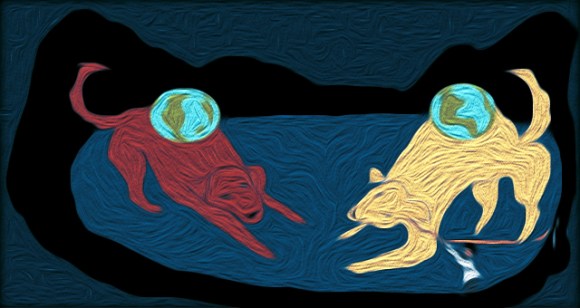
On the Backs of Two Dueling Dogs by Andie Bottrell

backs of dueling dogs

Delivering cake for gender parity!

As an LAFPI blog reader, you are probably already familiar with The Kilroys, the gang of 13 Los Angeles-based playwrights and producers who, in their own words, “are done talking about gender parity and are taking action.” They make news every year when they publish The Kilroy’s List, an aggregation of the most recommended unproduced or underproduced plays by women and trans playwrights. In a way, they do this to call out any theatre that’s lagging in gender parity – simply by saying, hey, look, we did the work for you. Are you saying you can’t find great plays by women or trans writers? Produce one of these plays, to start with.

But the cool thing about The Kilroys is that they also show appreciation where it’s due. Hence the 2015 Kilroy Cake Drop for Gender Parity.

20151119_172055

Earlier this week Joy Meads emailed and asked if I could do The Kilroys a favor – could I deliver a chocolate cake to the Los Angeles Theatre Center on Thursday? It would be part of a nationwide celebration – thirteen theaters around the country would get delicious cake delivered to them by an ambassador playwright, to celebrate their leadership and commitment to gender parity.

As it happens, I have a special connection with the LATC myself since they co-produced my play In Love and Warcraft this season, in association with Artists at Play. I was thrilled to do it.

So along with twelve other playwrights across the country, I picked up a specially baked cake and delivered it to a theatre that means a lot to me. The lovely people at LATC, under the leadership of Jose Luis Valenzuela and Evelina Fernandez, are doing excellent work for under-represented communities, and they deserve cake every day! (Or whatever treat they please, this cake was DELICIOUS but I might not be able to have it every day.)

Check out all the photos from the various cake drops today by following the hashtag #parityraid and #cakedrop on Facebook, Twitter and Instagram.

In closing I’d like to echo the request that The Kilroys have made today.

Don’t see your favorite parity-achieving theater on the list? We hope you’ll show them some love. Send a social media shout-out (or a cake!) and buy a ticket to celebrate their commitment to producing work by women and trans* writers.

Let’s get to it then. The work continues!

#QueVivaLaMujer!
#QueVivaLaMujer!