Tag Archives: Leilani Squire

The FPI Files: Returning Soldiers Speak… Now, Their Families’ Stories

by Leilani Squire

I was born and raised in the military. My father was deployed on an aircraft carrier off the coast of Okinawa when I was born at Tripler Army Hospital on the outskirts of Honolulu. This was during the Korean War. He served thirty years in the Navy, which means I grew up inside the military complex.

It is different to be raised in the military instead of being raised in the civilian world. As I write this, I see how I really can’t explain the difference because I do not have a reference to what it means to grow up outside of the military. Perhaps this is one of the reasons I thought of the playwriting project Military Family Staged Readings—to better understand the bridge between the two worlds.

There is also a difference between those who wear the uniform and those who wait for the return of the deployed. Each experiences the military in a different way, and hard as we try, there remains a gap of understanding, of experiences. My father was deployed many times—leaving on a big ship and returning six months or a year later. When he left I was one way, and when he returned I was a different person. We both changed during his deployment and it took time to reconnect and establish our relationship as father and daughter.

You may wonder why I begin this blog post about a child whose father deploys to a far away country and what that has to do with playwriting and the theater. Most people in our society do not understand what it means to be a spouse, child, mother or father of those who wear the uniform.

a military funeral at Arlington National Cemetery

Since 2010, I have worked with Veterans helping them tell their stories through poetry, prose, and playwriting through the organization Returning Soldiers Speak. As rewarding and meaningful and important as this work has been, I yearned to do something different. I wanted to honor the family members of the military.

I guess you could say that I wanted to honor my mother who was a military wife for thirty years. And my sisters who moved from place to place with each new set of orders. And that little girl who waited for her father’s return. So, I wrote a proposal of a playwriting project for Veterans and family members—playwriting workshops that would culminate in a series of staged readings for the public—and submitted it to the City of Los Angeles Department of Cultural Affairs.  We were awarded the grant (that is, a matching grant) and began the playwriting workshops last fall.

The interview process was challenging because each person was wonderful and full of potential and passion, but due to the constraints of our budget, we couldn’t accept all of them.

Our playwrights are Benjamin Fortier, a Marine Corps Veteran who was in Fallujah in 2006; Gregory Hillman, a Marine Corps Veteran who was deployed to Afghanistan; Jeffrey Webster, a Coast Guard Veteran who does ceremonies for Veterans in Hospice; Bryan Caldwell, a grandson of a Navy Captain; Denah Angel, a daughter whose father served in the Air Force during the Vietnam War; and Liisa Rose, a wife whose husband was an Air Force Colonel who served for almost twenty-nine years.

Some live in Los Angeles, others live in various parts of the country. The challenge has been how to bring all of us together—and so enter Zoom. It amazes me how intimate the workshops have been using this virtual platform.

Liisa Rose and her husband, Mark

One Saturday morning during our Zoom playwriting workshop, we were focusing on Liisa Rose’s play.  Her play asks the question: Is the current state of the country worth giving one’s life for? This is a provocative question to ask at any time, but to ask this question during these turbulent times is daring, brave, and important.

Support and Defend is the title of Liisa’s play and the main character faces the challenges of grieving the death of her husband (a character who died while deployed to Afghanistan) and raising her two almost-adult children. Much of Liisa’s play draws upon her own experiences in the military (but thank goodness she and her husband are living happily in Arizona).

At one point in our conversation, Liisa began telling us about a very personal experience that happened when her husband returned home from yet another deployment. I asked her if she had written about that and she said no. I suggested she write a monologue for the main character. She did. And then she wrote a scene based on their experience. It is one of the most powerful things I have ever heard or read.

She debated whether the scene belonged in the play, and if it did, where in the play’s structure would the scene reveal what it needs to reveal? She also wondered what her husband would say if she told him that she wanted to write this scene. He told her that would be okay. And ultimately, we decided that the play needs it.

It has been my honor to work with Liisa; she is a good playwright and has written an important play. The question she poses about weighing the current state of one’s country drives the story forward, and invites us to look with new awareness and search for an answer. After each reading, the playwright and the audience will engage in dialogue. I am curious what shape the dialogue will take after hearing Support and Defend.

Denah Angel Shenkman

Our other wonderful female playwright is Denah Angel Shenkman. I know Denah from Ensemble Studio Theatre/LA where we have worked together for many projects—I as a playwright and Denah as an actor.

A while ago, Denah told me the story about the Greek side of her family. During World War Two, the family’s house was taken over by the Nazis and her two aunts had to fend for themselves. They eventually escaped and found their way to America and joined their father. Theirs was complicated journey and a fascinating journey. I knew this project would be an opportunity for Denah to begin writing about her ancestors.

In writing her play, Denah has drawn upon her family’s story, and at the same time embraced the creative process of letting the story and the characters define the play. She has known all along what story she wants to tell, and it has been exciting to watch her take the leap into an unknown place and find the elements and aspects of the characters and their journeys.

One of the first times (if not the first time) Denah, Jim Lunsford (our wonderful dramaturge) and I met, she said that she wanted to write a love story. She wanted to show the complexities of what it means to live during war and to discover love in that harsh and brutal world. She began with three characters, added another character, and then another character to deepen and strengthen the theme, conflict, story and plot. She has drawn upon her Greek heritage in subtle and not-so-subtle ways that add spice and flavor, history and authenticity to the play. How she weaves Greek mythology throughout the characters’ lives—their relationships and their dialogue—makes sense in this world of her creation, and invites us to envision what it means to live in a place rooted in mythology.

We might inquire: How does ancient mythology speak to me in the 21st century? What can I learn? How might I use myth to create myth? What can I learn from the historical context of the play that will serve me during these turbulent times? For me to ask such questions means the playwright has done the work and written a play of meaning and authenticity. I am excited to bear witness to the dialogue between the playwright and the audience after the reading of An Era.
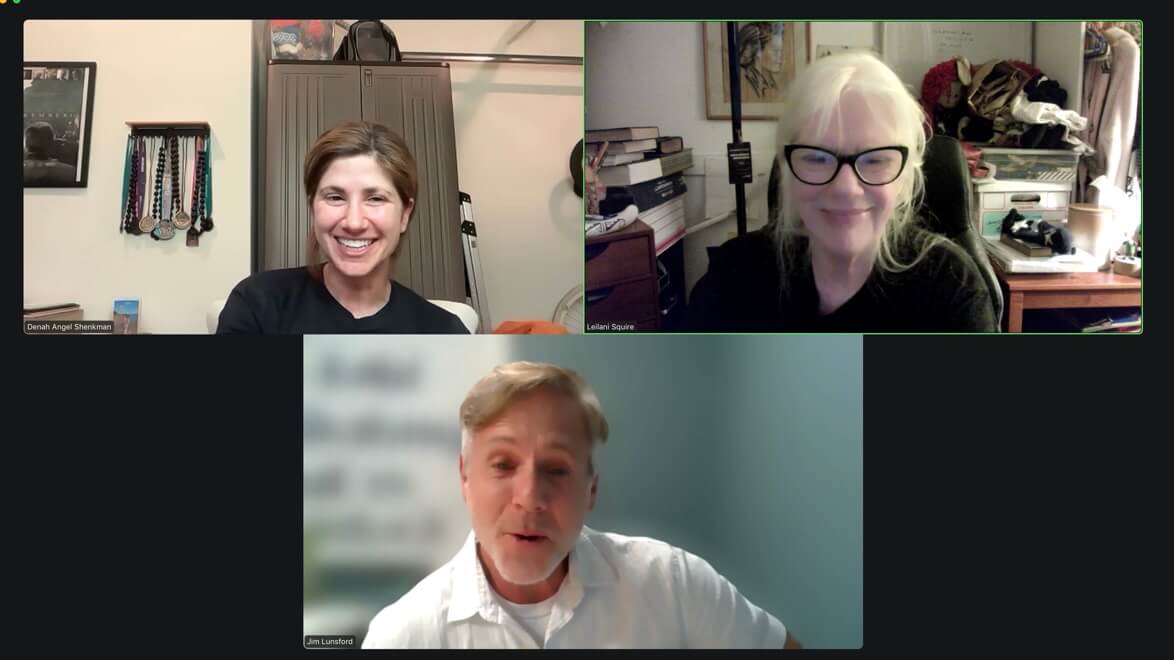
Denah Angel and Leilani Squire (top, l to r) with dramaturge Jim Lunsford

I must give a shout out to Jim Lunsford, our incredible dramaturge. I couldn’t have done this project without him. He understands theater in a way that I wish I did. He sees through to the essences of structure in a way that I wish I did. He envisions the whole picture, while I see the specifics—we make a wonderful team.

I am directing An Era and honored and excited to be doing so. Keith Szarabajka and Joe Garcia will direct readings as well.

The staged reading series begins with Denah Angel Shenkman’s An Era on March 25 and closes with Liisa Rose’s Support and Defend  on April 29.

There are four other staged readings in the series that will also be awesome:

  • April 1 – Gregory Hillman, Self-less
  • April 8 – Benjamin Fortier, The Park
  • April 15 – Jeffrey Webster, Killing to the Sound of Trumpets
  • April 22 – Bryan Caldwell, Flowers From Hell

I hope you join us for these wonderful plays, engage in the dialogue after the reading,and enjoy the camaraderie of community.

Military Family Staged Readings take place March 25 – April 29, Wednesdays at 7:30pm, followed by dialogues between the playwrights and audiences. The readings take place at Sawyer’s Playhouse, 11031 Camarillo Street in North Hollywood, CA. Donations will be gratefully accepted. For more info, visit returningsoldiersspeak.org/military-family-staged-readings-project

The FPI Files: Laura Shamas Recounts Her Passion For “Four Women in Red”

By Leilani Squire

I recently had the honor of speaking with playwright and LAFPI Co-Founder Laura Annawyn Shamas (Chickasaw Nation). She wrote Four Women In Red now playing at The Victory Theatre in Burbank.

The play is about four Indigenous women who are the survivors of their missing relatives and friends, who are devastated by the loss, and yet who continue to search for the missing against all odds of finding their loved ones.  Laura said that it was hard writing the play because of the subject matter. But she is passionate about it and wants change and so she wrote a play. She realizes that it is hard on the actors and the director because they have to relive the trauma during the rehearsal process and performances. However, the director and the actors are willing to go to those places over and over in spite of the emotional toll doing the play has on them.

“The ending is something people have not seen before,” Laura said when we talked about the power and beauty of the production. The four women onstage create a memorable final stage picture of unity and determination … and defiance.

Zoey Reyes, Harriette Feliz, Jehnean Washington and Carolyn Dunn in “Four Women In Red” – Photo by Tim Sullens

In the play, one of the female characters says, “It always falls to us.” It is the women who keep taking action. It is the women who support each other. It is the women who keep the hope alive. The four characters embody the strength and resilience of Native American Women, and the search for justice. Laura said that “these women” have been resisting systemic oppression for hundreds of years. They have been fighting against the oppression. What she means by “these women” are not only the four women in the play—but all Indigenous women.

She said, “Story is medicine. This is what is taught in the tribal way. This is what the tribes teach.”

Playwright Laura Shamas – Photo by Stephanie Girard

Laura believes in the magic of theater and theater as an art form. She went on to say, “The playwright helps the audience to experience a temporary collective. There is an electrical, an alchemical response when sitting in the audience with others and watching actors perform on stage. A lived interaction. An aliveness. Something about the live interaction of experiencing the actors in real time – this is an active response. Not passive like watching a streaming video or a movie that takes place in the past, even if the story is in the present. Watching a play on stage is active – living and experiencing in the moment. We need this kind of collective experience now as a society. We need to cry and laugh together. This is what theater is about. This is the magic of theater. And we need the magic and the collective more than ever.”

With all the divisiveness and prejudices and everything else happening in the world, we do need the magic and the collective experience of live theater more than ever. As I sat in the audience and watched Four Women In Red, I felt as if I was experiencing the story and the journey of the characters in community. I felt the immediacy and aliveness of each moment. and I sensed the audience experiencing the same.

Harriette Feliz, Jehnean Washington, Carolyn Dunn and Zoey Reyes – Photo by Tim Sullens

I asked Laura, what did she learn as a person as she wrote the play. Her answer encompassed more than the writing of the play, but the process and journey that began five years ago: “I will always need to keep learning. I will always try to keep learning. As an artist.”

Laura said she was at every rehearsal, wondering how to make it better, and that she changed words during the last of the rehearsals. She added, “I feel very humbled by the show. I still have a lot to learn about the topic.”

Laura hopes to bring attention to the important topic of Missing and Murdered Indigenous Women and Relatives. She hopes to shine a light on the issue so that people will be aware of what is happening and to take action. And she says she is proud to have been a small part of the larger picture. “If some change happens, no matter how small, if someone takes action because they saw the play, then this five-year journey will be worth it.”

“My hope is that once they see the play, they can’t stop thinking about the issue – the issue of missing native women,” Laura continued.

The systemic oppression Native women experience is another issue that people need to bring attention and take action to in order for change to happen. “A chorus of voices to bring real action is what is needed now, “ she said.

Carolyn Dunn, Jehnean Washington, Harriette Feliz and Zoey Reyes – Photo by Tim Sullens

I said that, to me, the ending of the play is a call to action. She thanked me for seeing that. She emphasized that, “There are a few calls to actions in the play.”

Laura suggested a few ways that we can help bring awareness and to take action:

  1. Call your Representative and ask what they are doing about the issue.
  2. Go to National Indigenous Women’s Resource Center (NIWRC) website and donate.  The website is https://www.niwrc.org
  3. Be part of a search for Missing and Murdered Indigenous Women.  

During opening weekend, Tayana Viscarra (Piro-Tewa Pueblo, Apache, Kumiai, European) and Norm Sands (Apache, Yaqui, European), co-founders and leaders of Way of the Sacred Mountain, an indigenous-led, grassroots partnership providing healing and support for families and communities affected by Missing and Murdered Indigenous Women (MMIW), talked to the audience after the performance. They talked about conducting searches, and they may be a place to find how to be part of a search. Their website is https://www.wayofthesacredmountain.org

At the end of our dialogue, Laura offered this advice to playwrights: “Write something you care about. Write what you’re passionate about. What is it you care most about and what do you want to tell the audience about?”

I thought of the plays that I’m writing and how I’m passionate about them and how I love the characters and how they are alive within my life and how I’m alive with their lives. And Laura’s advice makes me even more determined to finish the plays – even though one may always be working on the play, according to Laura – and get it out into the world.

Four Women In Red” by Laura Annawyn Shamas (Chickasaw Nation), Directed by Jeanette Harrison (Descendent of the Onondaga Nation), Produced by Maria Gobetti runs through March 23, Friday and Saturday at 8:00pm and Sunday at 4:00pm, at The Victory Theatre Center in Burbank. For tickets call (818) 841-5421 or visit thevictorytheatrecenter.org.

The FPI Files: Sacred Listening to the Wounds of War

by Leilani Squire

Over the past week, I’ve had the privilege of reading the full-length play Mama Mama Can’t You See written by Stan Mayer and Cecilia Fairchild, speaking with Cecilia, and then seeing the rockin’, brave, and surreal production at Coin & Ghost directed by Zach Davidson on Veterans Day, which was opening weekend.

The promotional materials tell us that Mama Mama Can’t You See, “Isn’t a play about war. It is a play how to tell a war story.” For me, it’s about memory and how memory pushes and pulls within our being in a myriad of ways of complexity and authenticity.

The play is based on Stan Mayer’s life as a Marine during Operation Iraqi Freedom in the early 2000s. There are eight characters in the play: four Marines who live within the realities and memories of that war, and four young women who embody another aspect of war. Cecilia pondered for a long time what to call these four characters—women who provided sex for a living during the Civil War, and have direct encounters with the Marines of 2005 Iraq.

For Cecilia, modern terminology didn’t fit the female characters she envisioned, who would tell this evocative and complicated part of the story. She discovered through her research that the etymology of whore is unblemished and meant “dear, loved, and desire” in distant times. And so she ran with her instincts and called these four characters whores, women who use their bodies to satisfy the needs and desires of the battle-weary, and to buy food for their mothers and their baby sisters.

Kathleen Leary, Marguerite French, Carene Rose Mekertichyan, Hannah Trujillo as the Whores in Coin & Ghost’s “Mama Mama Can’t You See” – Photo by Meredith Adelaide

During our conversation about the Whores, I inquired about the characters’ origin and their meaning within the context of Stan’s story. Cecilia talked about “sacred listening” and how she was “being pushed this way to tell the story this way.” I loved when she connected this push and pull to the act of sacred listening and how this enabled the characters to appear and unfold before her.

Playwright Cecilia Fairchild

I knew then that she understood something about war and love, death and loss, and survivor’s guilt that most of us don’t. Perhaps I understood as well because I was born in an Army hospital during war and raised in the military, and have been working with veterans, active duty, and their families since 2010 to empower them tell their stories through the written word. I have learned through experience that listening is one of the most important and crucial aspects of this kind of work, which enabled me to understand Cecilia’s world and process as a playwright. To truly listen is not an easy task, but it is vital for the playwright to still and to listen because that is when and where the magic happens.

Each of us has a process when we write. For Cecilia, she says it is like “reading your own tea leaves as you’re writing.” What amazing and evocative tea leaves live inside her creative imagination! To her, “the theater is a place where we can dream” and where “anything can happen.” Mama Mama Can’t You See embodies a dream—or nightmare might be a more appropriate word—where anything can happen.

Cecilia also drew upon personal experience to breathe deeper layers and aspects into the characters and the play. She attended the ten-year anniversary of the pivotal and deadly firefight Stan experienced during his first tour in Iraq—the firefight that is the inspiration for the play. At the reunion in San Antonio, Cecilia listened to the war stories of those who survived and those who died on the battlefield. And she has carried what she heard ever since. Even though she didn’t experience the battle firsthand, she lives with the stories of the dead and the survivors, feeling the loss of life and innocence and knowing, “war is a cavern of death and near death.”  Then she took my breath away when she said: “They died inside of me anyway, the men who died at war.” This is what sacred listening looks like in our mundane reality. This is what carrying the wounds of war that others experience looks like. This is what carrying the memories of those who experience the realities of war looks like… And for all of that, I honor and respect her deeply.

“Mama Mama Can’t You See” Ensemble – Photo by Meredith Adelaide

Towards the end of our dialogue, I said to Cecilia, “You’re the Civil War Whore.” She gently agreed. And I could hear the depth of how my knowing this—how my speaking those words out loud—resonated within her. In a way, what I experienced at that moment is sacred listening—how I could hear her heart and memories, her love and loss, within my heart and my memories.

I also asked her what she wanted me to experience, to feel as I would sit in the audience and watch the play unfold inside the theater. She responded, “[I’d like] for your body to open and molecules be rearranged somehow.“ She wanted the experience to be “almost like a spell”… “a series of words [that] would play across your body” (love this one!!) and for me and audiences to have a “thrilling out of body experience.”

What a wish list for a playwright!

Stan Mayer and ensemble – Photo by Meredith Adelaide

Even though Cecilia wasn’t involved in this current production at Coin & Ghost, her heart and her story are ever present and alive on the stage. As I sat in the darkened theater during the performance, I felt myself come alive as the actors moved with primal energy and danced seductively. The dialogue played across my body, casting a spell on me and taking me places I dared to go. The bluesy rendition of the military cadence “Mama Mama Can’t You See” sung by one of the Whores as she walked to the Marine laying on the battlefield, haunts me—I can’t get it out of my mind and heart. And to be honest, I don’t want to.

Coin & Ghost’s “Mama Mama Can’t You See” runs through December 10th at Studio/Stage on Thursdays, Fridays and Saturdays at 8pm and Sundays at 7pm (dark November 23 through November 26.) For tickets and information, visit  coinandghost.org.

Know a female or FPI-friendly theater, company or artist? Contact us at lafpi.updates@gmail.com & check out The FPI Files for more stories.

Want to hear from more women artists? Make a Tax-Deductible Donation to LAFPI!

Donate Now!

#FringeFemmes Check-Ins: Runaway Rue

by Leilani Squire

Quick peeks at #HFF23’s “Women on the Fringe” by Fringe Femmes who are behind the scenes this year. Click Here for all Check-Ins

Fringe Femmes

WHO:  Stacey Weingarten

WHAT:  Runaway Rue

WHERE: The Actors Company (Other Space Theater) 916 N. Formosa Av

WHY: Because it is wonderful to enjoy and laugh and remember what it’s like to love and be loved by furry friends! And the puppets are absolutely wonderful—I fell in love with all of them. What a lovely way to spend a Sunday afternoon. One of my favorite parts (other than the singing and the puppets) was watching a child watch the musical with complete engagement and wonder. If you have children, be sure to take them to see this delightful and fun musical that teaches us the true meaning of home. You just might giggle and sing on the way out of the theater. 

HOW: https://www.hollywoodfringe.org/projects/9675

Click Here to Find More “Women on the Fringe!”

#FringeFemmes Check-Ins: Grown Up Orphan Annie

by Leilani Squire

Quick peeks at #HFF23’s “Women on the Fringe” by Fringe Femmes who are behind the scenes this year. Click Here for all Check-Ins

Fringe Femmes

WHO:  Katherine Bourne Taylor

WHAT:  Grown Up Orphan Annie

WHERE: The Broadwater (Studio) 1078 Lillian Way

WHY: Fun and endearing! The playwright/actress/singer/songwriter, Katherine Bourne Taylor, delights and entertains with her solo performance of Little Orphan Annie all grown up. Katherine sings and reflects and eulogizes about her long lost father, all the while looking for a new best friend and engaging the audience with a sly smile—to the delight of the audience. There was a lot of laughter and clapping, which was contagious. But don’t be fooled—there are provocative issues woven throughout the clever performance. 

HOW: https://www.hollywoodfringe.org/projects/9585

Click Here to Find More “Women on the Fringe!”