All posts by Calendar Updates

The FPI Files: Returning Soldiers Speak… Now, Their Families’ Stories

by Leilani Squire

I was born and raised in the military. My father was deployed on an aircraft carrier off the coast of Okinawa when I was born at Tripler Army Hospital on the outskirts of Honolulu. This was during the Korean War. He served thirty years in the Navy, which means I grew up inside the military complex.

It is different to be raised in the military instead of being raised in the civilian world. As I write this, I see how I really can’t explain the difference because I do not have a reference to what it means to grow up outside of the military. Perhaps this is one of the reasons I thought of the playwriting project Military Family Staged Readings—to better understand the bridge between the two worlds.

There is also a difference between those who wear the uniform and those who wait for the return of the deployed. Each experiences the military in a different way, and hard as we try, there remains a gap of understanding, of experiences. My father was deployed many times—leaving on a big ship and returning six months or a year later. When he left I was one way, and when he returned I was a different person. We both changed during his deployment and it took time to reconnect and establish our relationship as father and daughter.

You may wonder why I begin this blog post about a child whose father deploys to a far away country and what that has to do with playwriting and the theater. Most people in our society do not understand what it means to be a spouse, child, mother or father of those who wear the uniform.

a military funeral at Arlington National Cemetery

Since 2010, I have worked with Veterans helping them tell their stories through poetry, prose, and playwriting through the organization Returning Soldiers Speak. As rewarding and meaningful and important as this work has been, I yearned to do something different. I wanted to honor the family members of the military.

I guess you could say that I wanted to honor my mother who was a military wife for thirty years. And my sisters who moved from place to place with each new set of orders. And that little girl who waited for her father’s return. So, I wrote a proposal of a playwriting project for Veterans and family members—playwriting workshops that would culminate in a series of staged readings for the public—and submitted it to the City of Los Angeles Department of Cultural Affairs.  We were awarded the grant (that is, a matching grant) and began the playwriting workshops last fall.

The interview process was challenging because each person was wonderful and full of potential and passion, but due to the constraints of our budget, we couldn’t accept all of them.

Our playwrights are Benjamin Fortier, a Marine Corps Veteran who was in Fallujah in 2006; Gregory Hillman, a Marine Corps Veteran who was deployed to Afghanistan; Jeffrey Webster, a Coast Guard Veteran who does ceremonies for Veterans in Hospice; Bryan Caldwell, a grandson of a Navy Captain; Denah Angel, a daughter whose father served in the Air Force during the Vietnam War; and Liisa Rose, a wife whose husband was an Air Force Colonel who served for almost twenty-nine years.

Some live in Los Angeles, others live in various parts of the country. The challenge has been how to bring all of us together—and so enter Zoom. It amazes me how intimate the workshops have been using this virtual platform.

Liisa Rose and her husband, Mark

One Saturday morning during our Zoom playwriting workshop, we were focusing on Liisa Rose’s play.  Her play asks the question: Is the current state of the country worth giving one’s life for? This is a provocative question to ask at any time, but to ask this question during these turbulent times is daring, brave, and important.

Support and Defend is the title of Liisa’s play and the main character faces the challenges of grieving the death of her husband (a character who died while deployed to Afghanistan) and raising her two almost-adult children. Much of Liisa’s play draws upon her own experiences in the military (but thank goodness she and her husband are living happily in Arizona).

At one point in our conversation, Liisa began telling us about a very personal experience that happened when her husband returned home from yet another deployment. I asked her if she had written about that and she said no. I suggested she write a monologue for the main character. She did. And then she wrote a scene based on their experience. It is one of the most powerful things I have ever heard or read.

She debated whether the scene belonged in the play, and if it did, where in the play’s structure would the scene reveal what it needs to reveal? She also wondered what her husband would say if she told him that she wanted to write this scene. He told her that would be okay. And ultimately, we decided that the play needs it.

It has been my honor to work with Liisa; she is a good playwright and has written an important play. The question she poses about weighing the current state of one’s country drives the story forward, and invites us to look with new awareness and search for an answer. After each reading, the playwright and the audience will engage in dialogue. I am curious what shape the dialogue will take after hearing Support and Defend.

Denah Angel Shenkman

Our other wonderful female playwright is Denah Angel Shenkman. I know Denah from Ensemble Studio Theatre/LA where we have worked together for many projects—I as a playwright and Denah as an actor.

A while ago, Denah told me the story about the Greek side of her family. During World War Two, the family’s house was taken over by the Nazis and her two aunts had to fend for themselves. They eventually escaped and found their way to America and joined their father. Theirs was complicated journey and a fascinating journey. I knew this project would be an opportunity for Denah to begin writing about her ancestors.

In writing her play, Denah has drawn upon her family’s story, and at the same time embraced the creative process of letting the story and the characters define the play. She has known all along what story she wants to tell, and it has been exciting to watch her take the leap into an unknown place and find the elements and aspects of the characters and their journeys.

One of the first times (if not the first time) Denah, Jim Lunsford (our wonderful dramaturge) and I met, she said that she wanted to write a love story. She wanted to show the complexities of what it means to live during war and to discover love in that harsh and brutal world. She began with three characters, added another character, and then another character to deepen and strengthen the theme, conflict, story and plot. She has drawn upon her Greek heritage in subtle and not-so-subtle ways that add spice and flavor, history and authenticity to the play. How she weaves Greek mythology throughout the characters’ lives—their relationships and their dialogue—makes sense in this world of her creation, and invites us to envision what it means to live in a place rooted in mythology.

We might inquire: How does ancient mythology speak to me in the 21st century? What can I learn? How might I use myth to create myth? What can I learn from the historical context of the play that will serve me during these turbulent times? For me to ask such questions means the playwright has done the work and written a play of meaning and authenticity. I am excited to bear witness to the dialogue between the playwright and the audience after the reading of An Era.
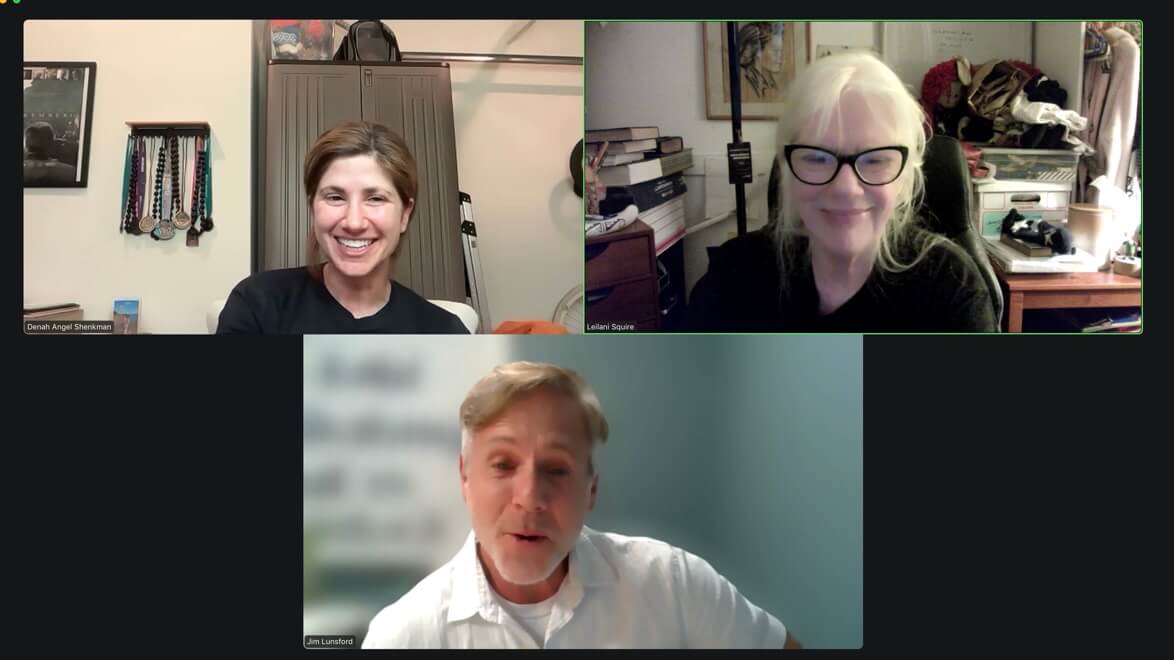
Denah Angel and Leilani Squire (top, l to r) with dramaturge Jim Lunsford

I must give a shout out to Jim Lunsford, our incredible dramaturge. I couldn’t have done this project without him. He understands theater in a way that I wish I did. He sees through to the essences of structure in a way that I wish I did. He envisions the whole picture, while I see the specifics—we make a wonderful team.

I am directing An Era and honored and excited to be doing so. Keith Szarabajka and Joe Garcia will direct readings as well.

The staged reading series begins with Denah Angel Shenkman’s An Era on March 25 and closes with Liisa Rose’s Support and Defend  on April 29.

There are four other staged readings in the series that will also be awesome:

  • April 1 – Gregory Hillman, Self-less
  • April 8 – Benjamin Fortier, The Park
  • April 15 – Jeffrey Webster, Killing to the Sound of Trumpets
  • April 22 – Bryan Caldwell, Flowers From Hell

I hope you join us for these wonderful plays, engage in the dialogue after the reading,and enjoy the camaraderie of community.

Military Family Staged Readings take place March 25 – April 29, Wednesdays at 7:30pm, followed by dialogues between the playwrights and audiences. The readings take place at Sawyer’s Playhouse, 11031 Camarillo Street in North Hollywood, CA. Donations will be gratefully accepted. For more info, visit returningsoldiersspeak.org/military-family-staged-readings-project

From Instigator Nancy Beverly: Picture This – Part 3

This week, we’re sharing some fun stuff from LAFPI Instigator (and former blogger) Nancy Beverly! Check out below for her latest Substack Post. And play catch up and stay in the loop at substack.com/@hikernb

Climbing Mt. Olympus??

(Yeah, that looks a little steep, doesn’t it?)

Should I spend $200 to buy my theatre pal Marc’s Olympus OM-1 camera at the end of my sophomore year of college????

Here’s some back story from my childhood to explain why this was such a big decision:

When I was in the third grade, men in suits came to the front door. I thought they were insurance salesmen because back then, those type of guys came a knockin’ to sell policies. But THESE Men in Black took the car away. Oh. NOT insurance guys. I later learned the term Repo Men. As in repossession. Apparently Dad had fallen behind on the payments for our Thunderbird.

We went through a bunch of cars the next few months. Dad had a little red Corvair for a bit…

… not to be confused with a snazzy little red Corvette and no need to cue up Prince’s song.

Then Dad got into an accident where the Corvair was totaled. Great. The guy living next door to us was a mechanic so he loaned us an ancient gray clunker from the 1940s. Eventually we got a green 1951 Hudson that was the color of Dino the Dinosaur (of Sinclair gas stations fame) – and it was about the same size.

At first I was okay with Green Dino, it beat to hell and back driving around in that gray clunker. I showed my aunt (she was just six years older than me) that the back seat was so wide I could lay down across it without having to bend my knees. She rolled her eyes implying the Hudson wasn’t even remotely cool, since this was the mid-60s. Shame washed over me.

About this time of us going through cars left, right and sideways, I became fascinated with Mr. Potato Head. I’m not sure why. I already had some Legos and had started collecting Matchbox cars. Maybe it was the fun of creating a funny face, so I asked my mom if I could have a Mr. Potato Head.

She said no, we couldn’t afford it. Wanna know how much Mr. Potato Head cost in the mid-60s? Ninety-eight cents. I’m not kidding.

I begged and pleaded with my mom until she finally drove us down to Ayr-Way where she bought me one. In hindsight, I’ve often regretted pushing Mom so hard for that toy… but when you’re in early grade school, how else do you stand up for yourself?

I did have a small plastic bank back then (it looked like a vault)…

… where I put my tiny allowance when Mom could afford to give me a nickel or a dime (my job was to take out the trash and dry the dishes). But Dad stole money from the plastic vault one Saturday morning when he thought I was asleep so he could go buy coffee at the corner diner. I ratted him out to Mom and she chastised him big time. I don’t remember him paying me back.

So you can see why I was nervous and my mom was freaked out by me wanting to spend $200 on Marc’s Olympus OM-1 35 mm camera.

How could I even afford it, you ask? Well, I worked summers at Eagle Creek Park in Indianapolis to save up for college, plus I did work-study jobs at the University of Evansville (set building, publicity, box office), and I got grants (BEOG – the Basic Educational Opportunity Grant) and scholarships. No loans, I did NOT want to end up in debt like my dad.

All of that added up to my bank account giving me the green light to buy Marc’s camera. Not to mention my intuition and instincts that were yelling, “GO FOR IT!” So, I bought it. And used it for close to 30 years. A truly fabulous investment.

(It says 28 millimeter but the film that fit inside was called 35 mm)

Now that I had this fancy schmancy camera, what was I going to take pictures of? Surely more than just water droplets on clover and raindrops on roses (as much as I loved Julie Andrews in The Sound of Music)…

Wait, hang on… I was in the Drama Dept. at U of E…

Yes, photo ops there started to call my name…

(An action shot of mine from The Boyfriend, a musical production at the University of Evansville)

Go Here to Read and Subscribe to Nancy’s Substack

The FPI Files: “The Great Jheri Curl Debate” Comes to Life at East West Players

By Alison Minami

When Inda Craig-Galván was a young child growing up on the Southside of Chicago in the early eighties, her mother, a trained beautician, started losing clientele with the rise of at-home hair kits. In need of steadier income, she took a job at a beauty care products store owned by a Korean immigrant. The owner, unable to pronounce her name, renamed her Julie, which had always felt wrong to Craig-Galván. But as she got older, she realized that in many ways the two had had a mutually beneficial arrangement—for example, her mother was able to bring her daughter to work and the owner was able to pay her in cash. This unlikely pairing of two people at the margins is the inspiration for Craig-Galván’s new play “The Great Jheri Curl Debate,” which is having its World Premiere at the East West Players of Los Angeles.

Ryun Yu as Mr. Kim and Julanne Chidi Hill as Veralynn. Photo by Steven Lam.

In the play, Veralynn takes a job at Mr. Kim’s beauty supply store. The scenario and setting may be seeded from real life, but the story that unfolds is fully Craig-Galvan’s imaginative exploration of two people of color who are both trying to survive while negotiating shared space. Craig-Galván wanted to write an intersectional play bringing two communities uncommonly represented together that wasn’t about war or marriage, but rather about “dealing with each other, finding common ground, misunderstanding each other, and overstepping each other.” As a Black woman and an Asian immigrant with a heavy accent, Veralynn and Mr. Kim must come face-to-face with the racial stereotypes and cultural barriers between them. In so doing, they take the difficult but brave steps to bridge their divide and acknowledge their humanity.

A hallmark of Craig-Galván’s playwriting is an element of magical realism, and this play does not disappoint. While Veralynn works at the store, the beauty poster advertisements come to life, haunting and prodding her as she tries to build connection with Mr. Kim.

Inda Craig-Galván

 In her own words, Craig-Galván is “obsessed with using storytelling in a super theatrical way,” in “exploring someone’s inner mind—their thoughts and their skewed vision of life.” The posters are a window for both Veralynn and Mr. Kim as we discover how much they’ve sacrificed in the way of their own artistry just to live in America. Thematic to the play is the question, as Craig-Galván posits, “How do we continue to find and make art where we are made to feel unwelcome?” It’s a fitting question for anyone trying to make meaning out of their creative lives whilst struggling with the economic pressures of American capitalism. 

 Bringing together all the elements of this play took considerable creative collaboration. Under the dramaturgy of Playwright Alice Tuan, the play was developed in the East West Players’ new play development Playwrights Group. Director Scarlett Kim, also the Associate Artistic Director at Oregon Shakespeare Festival, brought her background in theater and video and technology to the project, as well her own Korean immigrant perspective, which was integral to the fleshing out of Mr. Kim. Because of the extended developmental support, the play had the great fortune of actor input by lead actors Julanne Chidi Hill and Ryun Yu.

Scarlett Kim

For Kim, the play was an ideal project where her many skills and sensibilities could converge. She describes the play as depicting “how two characters move beyond prescriptions of what society tells them”, and one that refuses to fall into a right-or-wrong, black-or-white binary or be told through a white male gaze. One of Kim’s driving values as an artist and director is what she describes as unclassifiable spaces, a “central framework for life and art.” In many ways, she says this play is “the story of unclassifiability in both content and form.” The integration of multimedia to carry out the fantastical elements of the play is magical and isn’t additive but rather illuminating to the characters’ inner lives.  

Both Kim and Craig-Galván rave about this female-powered creative collaboration, with Kim calling it a “dreamy, joyful, generous” process and Craig-Galvan amazed at the visual interpretations of her own, as she quips, “ridiculous stage directions.” The show promises to be a truly theatrical event.

Click Here for More Info on “The Great Jheri Curl Debate,” playing at East West Players through October 9th.

Know a female or FPI-friendly theater, company or artist? Contact us at lafpi.updates@gmail.com & check out The FPI Files for more stories.

Want to hear from more women artists? Make a Tax-Deductible Donation to LAFPI!

Los Angeles Female Playwrights Initiative is a sponsored project of Fractured Atlas, a non‐profit arts service organization. Contributions for the charitable purposes of LAFPI must be made payable to “Fractured Atlas” only and are tax‐deductible to the extent permitted by law.