Act Two Hell

I am in act two hell.

You start out with such fire and confidence and vigor. Your characters come alive. They hold your hand and lead you through all the set up scenes, sprinkling potential conflicts like breadcrumbs along the way. The end of act one comes naturally. You feel so good about the piece, you want to schedule a reading, cast your actors, think about where you want it to premiere.

And then it’s time to finish the darned thing.

Act two inspiration is a bit slower. Somehow, the tension seems a little deflated. Like the audience had one glass of wine too many during the intermission. Wake up, playwright! You meander around, hoping for inspiration. And wake up in a cold sweat, convinced that Act one is totally boring, uninspired, stupid. You have the urge to completely tear it apart. Fix it. Tinker with everything.

This is the devil whispering in your ear.

Or, as my Skype writing buddy in Omaha puts it, “Why do plays need second acts anyway? Lazy audience. Why can’t they just work it out themselves?” And at this point in the writing process, you tell yourself, they’ll probably do a helluva lot better than you.

How to escape these many circles of hell? I’ll share my laundry list of tricks tomorrow.

www.kittyfelde.com

Inspiration from the past and now present

Click here to see Todd Barton's video link.

This week has been a surprise. I’ve written on a blog for the first time.

I’ve been able to write – bits and drabs – about mannequins and costumes.

I wasn’t able to write about character arcs or third act slumps or about the craft of playwriting.

But amidst my own mind babble (shut up with the complaining: no one’s making you write) or inspiration (connecting threads from the past), I let go of some of my dread.

I wanted to share this link from Todd Barton, a friend from my past; he’s a great feminist, composer and artist. Years ago, we collaborated on a great idea for a children’s interactive video game (build your own flying carpet/city with music you create in a keyboard game). It was a great idea…in its time.  But he’s created some inspirational music for theatre that can spark some great ideas and feelings. I asked his permission to post his link here.

Thank you to LA FPI for giving me the nudge to share on this blog. I begin again tomorrow with my writers group.

So here’s to tomorrow.

Masquerades and the Shadow Self

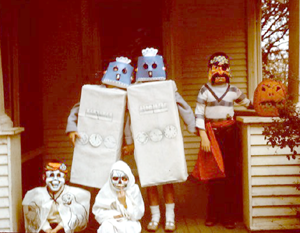
Halloween is coming. Yes, the chance to dress up in a scratchy plastic mask and run screaming through dark neighborhoods and get free candy.  At least that’s the way I remember it.  But times are different. There used to be hordes of young children, without parents or flashlights or fireproof costumes, roaming the sidewalks experiencing unsupervised tragedies on Halloween.

Halloween was the chance to live out your fantasy of your evil twin, your secret self, your nemesis.

But I had my issues. I had an identical twin sister, and other, cuter siblings, and the wild card – a magical mother who could make any costume come to life. She made costumes for us as skunks, and cows, and Rosie the Maid from the Jetsons, and Pirates, a geisha, and bunnies and a horse that ended up tragically torn in two, and Elvis and a Christmas tree (with presents as feet), and a Black Eyed Susan, (and as my twin sister Susan defiantly explained to everyone “I am not a sunflower”). My mother gave us this idea that we could become anyone – if only with a plastic mask and a bunch of fabric. “Let’s see how this looks,” she would say. This would look like a bunch of fabric bunched up to look like a giant toenail. But somehow, with her imagination and with paint or some trim, or a bunch of buttons, eventually it became a kimono, or a queen’s cape, or a Spanish shawl.

I think this ritual of experiencing other cultures, other costumes, and personas, is a great way to experience the building blocks of theatre. How do you walk in these shoes? What does that wig feel like? That innocence of wanting to become someone else – “What are going to be for Halloween?” What freedom there is in the permission to become someone for a night, a party, a photograph.

Do Zombie’s wear tiaras? I guess I’ll find out this year….

Mannequins and First Drafts

There’s something about mannequins that remind me about a writer’s first/second/final drafts. Maybe it’s the skeletal frame, or the glassy eyes, but I’ve always been attracted to the idea of an idea taking a form, a body, a costume and then resembling a whole idea.

When I was a child my mother was keen on bringing us to every small town museum she could find, The Lobster Museum in Kittery Point, Maine, the Birch Tree Forest Museum in the White Mountains, Vermont – and some of them were quite surreal in their use of mannequins and taxidermy. The museum with the most sinister theatrical memory was a rather musty one in Fremont, Nebraska: “The American Indian in the American West” . It had a grouping of “American Indians” (this was before the term “Native Americans” or the discovery that Indians had tribes or nations of their own), anyway, the Indians looked very much like suburban neighbors who were dressed up in bad fitting leather outfits and they were lumped around a glassy eyed buffalo that they had apparently just killed (it looked like a moth eaten buffalo sofa with bent arrows coming out of it).  There was the square jawed Indian Chief with the Eagle feather headress, and the sullen young Indian brother, and the Indian Mom with a fake looking papoose on her back who was cleaning up the buffalo blood on the floor.  The caption read something to the effect of: “…here the Indian family are dressing one of the last of the buffalo, which were soon to be extinct on the plains of Nebraska….”

This exhibit really confused me. The Indians really didn’t look like Indians, they looked like white people with smudged dirt make up on, and the buffalo didn’t look dead, except for the glassy eye part, and I didn’t realize that buffalo were already extinct. I thought we saw one at Six Flags Over Texas the summer before. I didn’t quite get the distinction that they would soon be, perhaps, extinct on the plains of Nebraska. And I didn’t understand why they would be dressing a dead buffalo – (if he was dead, why would he need clothes on him?) – but when you’re nine years old and you know everything, you don’t ask questions.

So anyway, this really does bring me back to mannequins. The idea that they represent an idea – especially in theatre – as characters take shape in the time/place/class that they inhabit. I went to see the new costume exhibit at LACMA at the newly opened Resnick Exhibit this past weekend. The daring of these clothes really sparked my imagination – the curious nature of the each generation’s idea of the ideal form. It was inspiring. Especially the feathers in the hair.

Breaking Up An Iceberg With A Toothpick

……Is Hard To Do

(Writers Block)

You know that feeling when the words are tumbling out of you and you’re typing so fast because you’re raining dialogue, you’re percolating scenes and stomping exits and slamming doors and people in your head are yelling at you to hurry up – they’re waiting to get on stage. (…Okay, this could be a fantasy…)

And that’s only happened to me when I’m at writing retreats and I’ve paid money to show up and have actors read my scripts. But I swear, it has happened. I’ve had dreams where characters are chasing me like some kind of Twilight Zone episode and they’re trying to catch up to me to get to me to have their last say in the script I’m writing. I don’t mind that kind of scenario. I’d rather have that, then the Siberian exile I’m living in now.

Yeah, that island I’m living in now is called Writers Block. I know a lot writers have lived there, or had to visit. There are lots of life issues at play here: a family member is battling with cancer, my husband and I are dancing with unemployment and financial dread, and my life seems smaller and less assured.   What else.  My beloved Abyssinian cat is very ill and I know I love him too much in a way that people who own Abyssinian cats do. It’s a cult thing.

I guess it started with an unhealthy attachment to my last script. I loved it. I still do. Maybe you’re not supposed to love an unproduced script. Hell, it’s still out there, circling the zip codes.

But after I sent the script out I stopped writing. Six months of not writing was called “a break”. A restful pause. Refueling. A blank page. But then a series of life earthquakes happened and the writer’s block stayed.

So I teased the white fog to other names: Block head. Gnawing doubt. A log jam of inability. Did I fall out of love with writing? Did I use up all I had to say?

When I was a young actor, I played Eve in a production of “The Apple Tree” in Boston and worked with a very talented opera singer. He would save himself during rehearsals, barely coasting through the score and script, but then, eventually, gave an incredible performance in front of the audience. I thought he cheated the rehearsal process; but he shared, what was for him, a important part of his technique. “Darling,” he said, “God only gives us so many high notes; and I’m going to spend them with the audience, and not in the rehearsal room.” I might have thought he was selfish and a little precious, but I have to say, that technique really worked for him. He sang the role of Adam like an angel.

I’ve often wondered if there isn’t a part of my writer’s brain that is a little bit like his Adam. That it needs to get what it needs to write, and then –  it just turns off. I’m done. I’m tired of your stressful, fussy life. I’m tired of you giving the cat shots twice a day. I’m tired of the invisible cancer in the house, and the checkbook and the migraines and the grinding teeth.  So my brain just says:  I’m not writing.  Just not.  Just make me.

So I’ve been doing some “inspirations” to try and lure my curious self back into writing mode: meditation class, venturing out to see a couple of plays through LAFPI, embarking on a mannequin project, infusing vermouth. Getting engaged in something with my mind and hands has helped. Starting my writers group again will be a bit of trial when I really do not feel like writing at all, which I suppose,  is the point. Writing on this Writer’s Blog is supposed to be part of breaking the iceberg.  I don’t know that I can do this.  I will try.

And we’ll keep giving the cat his shots twice a day. That’s just part of the deal.

When I Knew

Earlier this month, Robin Byrd posed the question, when did you know you were a playwright in a blog full of questions.

I will attempt to answer her question.

I was in London (England), and I was looking out at the Thames. In my memory, the sun was shining although that probably was not the reality.

I had just written play. I had built this play moment to moment and gesture by gesture. It was everything I wanted in a play, and it all just felt right somehow.

I also felt drunk even though I hadn’t been to the pub. That was that. I was a playwright. I was f*cked. Yep, totally post-coital sore and tired f*cked.

Yep I was gonna live a life of insanity. I was gonna be low on cash and scrappy. I was gonna spend years working on an idea, an idea, an idea, an idea. I was gonna date poor actors (don’t date actors) and work crappy money jobs (usually alongside actors). I was gonna kick myself for not pursuing screenwriting and sitcom writing and journalism and ad copy. Then when I was done kicking myself, I was gonna beat myself up for not writing plays like everyone else.

Then I got older and a little bit smarter (but not much). But I was still breathing. And I was still writing. Yep, I was still drinking.

 I haven’t been back to London since then.

On Acting

This is the third piece in a series of three on the recent Gunfighter Nation production, LA History Project: Pio Pico, Sam Yorty, and the Secret Procession of Los Angeles. Enjoy!

I use to box (as in pugilism). I never competed, but I did spar. I remember one time, I was working out, and there was going to be a party at my gym in the evening. As I was getting ready to go into the ring, two 30-something ladies were hanging out behind me.

I could never do that. One said to the other.

I know, it’s just sooo brutal. The other said.

And with their voices in my head, I went into the ring and sparred for three rounds with Angel. I never let him get me in the corner by the way. He’d get a lot of guys in the corner, but he never got me there.

Those two ladies taught me a very important lesson about focus. Even if two seconds before I’m about to do something, I hear that voice that tells me no I can’t do it, I put it aside.  I can do it. I can (to quote the great Muhammad Ali) float like a butterfly and sting like a bee, your hands can’t hit what your eyes can’t see.

In addition to writing for Gunfighter Nation’s LA History Project, I acted in the show as well. This happened because I was in the right place at the right time. The writer of a short piece turned and asked me if I could act in his piece, and since I am trying to be more positive, I said yes.

I played the female Sam Yorty in an evening with several Sam Yortys. Sam Yorty was the mayor of Los Angeles during the Watts riots. My Sam Yorty comes onstage in a wheelchair and faces visions of death and an ideal Los Angeles, then dies.

I started off playing Sam depressed (always a solid fallback for me); then with the help of the writer, I took it to a more kinetic mean and angry place with dashes of Hunter S. Thompson, George W. Bush, and Peter Sellars in Dr. Strangelove thrown in for good measure. Along the way, I got a hat and sunglasses which allowed me to disappear completely and show a twisted, sickly, disgusting, dying character.  Ahhh, I was in acting heaven.

I do have a dark side. When I was in first grade, the nun said I had a bad temper. Now, I am a somewhat mature adult and keep it in check. I even drive around LA in a really mellow way.

When I was given permission to unleash hellfire, I knew I could do it. I could look out at the audience with hatred and anger and say, I hate this city. I could see the audience looking back at me, and I could hate them. I could be ugly and cruel and dying and disgusting. I could take it to that place and then roll off the stage and be fine. It’s just pretend. It’s okay.

We had six performances, so I got to die six times. The first night, I felt like I was operating from nothing more than guts. Then, I focused and listened to my fellow actors, and I started to understand the rhythms of performance of the piece.  

I think playwrights should try acting material they do not write. If anything, it will help them understand what goes into memorizing lines. It also got me rethinking about text word by word. How do words play in the mouth? To the ear?

Would I act again? Heck yeah. I really liked going to that dark place as an actor. Or maybe next time, instead of being ugly, angry, and mean, I could be pretty, happy, and sweet.

On Writing Collectively


Last month, I worked with Gunfighter Nation on LA History Project: Pio Pico, Sam Yorty, and the Secret Procession of Los Angeles, a collectively written evening of theatre. Some of my writing ended up in the evening, and I did a bit of acting as well. Today, I want to talk about the writing, and tomorrow, I will talk about the acting. 

Gunfighter Nation is a new Los Angeles theatre company of actors and writers who want to take theatrical possibility to the edge and beyond. It is a multigenerational company with members ranging in age from twenties to seventies. Playwright John Steppling is the artistic director. 

When I arrived on the scene in July, half of the writers in the company had already written pieces for the evening, and I felt myself playing a bit of research catch-up. The task was to write about Pio Pico, Sam Yorty, and the history of Los Angeles as a dark mass (which appealed to my Catholic upbringing).

For me, the hardest part of the whole process was the beginning. I was working with a company I didn’t know and an artistic director whose work I knew but I didn’t know his process. Because only half of the pieces had been written, I didn’t know exactly what the aesthetic was and felt a little lost in the dark.

However, lost in the dark is not a bad place to start writing.

I looked at my empty yellow pad, and my first thought was Pico and Yorty in a bar in hell. The bar is my fall back location. If I’m stuck, I go to the bar in my head. I can move through it with ease. By the way, I no longer go to an actual bar if I’m stuck while writing.

I also started to think about what Los Angeles meant to me. What is the Los Angeles I see? Then, I stumbled into something I had been thinking about for awhile. In Los Angeles, we are a city of millions, yet we hate crowds. We drive around in cars that separate us from each other. We collectively fear contact with strangers.

One could take this fear of crowd contact into a bigger American context and into an American obesity—we need lots of fat around ourselves in order to protect ourselves from cruel human dangers.

I started writing a monologue for a heavy woman. Like many in Los Angeles urbanites, she hates crowds and doesn’t want people around her. She also can’t breathe because the air in Los Angeles is bad. She just kept talking and talking. Her talk became a song of fear and non-contact. Stay Back! Stay Back! she shouts at the audience and the world.

I am not a monologue writer, but this woman was singing out. What can I do? I’m just the writer.

I brought the pieces into our next meeting. The Pico and Yorty piece didn’t feel right to me. It was sketchy, and there was no idea to it except putting Pico and Yorty together onstage in a bar.

Then, I passed the monologue to Tina Preston, an actress in the group, and told her that she was afraid and couldn’t breathe. Tina read the monologue cold out-loud. She got into a rhythm with it. She read and read, and when she was finished, I yelped. Yes, I actually yelped.

As a writer, I sometimes have moments which confirm to me why I do what I do and remind me that I’ve still got some juice in my brain. Such moments are rare and gold. This was such a moment.

As the whole evening started to form, I thought it would be cool if the monologue was cut up and served as a transition between longer pieces. The woman could run into characters entering for the next play. I also figured that if I kept the monologues short, I would leave the audience wanting more.

Working with Tina was a true writer/actor collaboration. Tina worked extremely hard to take my conceit and turn it into something human. In the course of our working, our character who was very vulnerable and afraid became powerful and present.

As we moved closer to opening, I realized that I wasn’t feeling the usual writer nerves because I didn’t have to carry all the ideas. The ideas belonged to all the writers. The pressure was off. What did I have lose? When you have nothing to lose, the work gets better.

As writers we are taught to write plays which are complete unto themselves. They can be short or long, but they must complete themselves. The idea must reach a conclusion.

 But

 When writing collectively, the goal is not to write to completion but to write to incompletion. It’s about the whole idea of the evening.   

 When we Americans hear words like collective or socialism, we get very scared. We don’t want to lose our American individualism. We want to be our lone ranger selves.

 But, in a collective where originality is prized, I found myself pushing the originality envelope because I was inspired by the writing around me. It’s like jazz. We were all playing a theme, but when we could break out and solo, ohhh we got hot.

 Because we writers had shared artistic ownership of the evening, I felt myself losing ego about the whole experience. It was going through me, but it wasn’t about me. It was about the group. And the result was work I am extremely proud of with a group of nonconformist artists who make sweet sweet jazz together.

 Gunfighter Nation has a collectively written Christmas Show in the works, and yes, I’m writing for that one too.

On Gunfighter Nation


When I was in college back in the last century, I read two plays by John Steppling in playwriting class. Like Beckett and Duras, his plays, Standard of the Breed and Sea of Cortez, showed me what a play could be.  Built on detail, the plays slowly form their own universes in a truly modern way. It might seem like nothing is happening in Steppling’s plays, but in the end, everything is happening.

 As for Steppling the person. he was in Europe for a decade and recently moved back to LA. I met Steppling via a virtual introduction by Alice Tuan this past July. I learned that he had a theatre company called Gunfighter Nation and also facilitated playwriting workshops.

 I went to a Gunfighter Nation company meeting at the end of July and was immediately put at ease by a multi-generational company of writers and actors with members ranging in age from their 20s to their 70s. John Steppling is artistic director, and his son, Lex Steppling is associate artistic director.

Gunfighter Nation had produced The Alamo Project, an evening of short plays written and performed by company members at the Odyssey Theatre in May. It had happened over two nights on a set for a different play. It had been well-received, and the company wanted to do a more ambitious evening.

 The next evening on their slate was a collectively written play called LA History Project: Pio Pico, Sam Yorty, and the Secret Procession of Los Angeles. With short plays by members of the company, the goal was to look at the history of Los Angeles through the lens of Pio Pico (the last Mexican governor of California) and Sam Yorty (mayor of Los Angeles during the Watts Riots). The evening would not be a chronological history lesson with a quiz afterwards. Instead, it would be a platform on which to ask questions about history, collective memory, and this place called Los Angeles.

 LA History Project happened over three weekends in September/beginning of October at the Lost Studio on La Brea. I both wrote for and acted in the play, and I am going to talk more in depth about those experiences on Tuesday and Wednesday (yes, I have a blogging plan).

In addition to collectively written work, the company also seeks to produce plays by its members. Next up is John Steppling’s new play, Phantom Luck, which opens on October 29th at the Lost Studio. If you want to see it, you can call 323-933-6944 for reservations.

Yes, I know this is the Los Angeles Female Playwrights Collective, and he is on the guy side of the gender fence. But it’s okay. Guys can write plays too.

After Phantom Luck, Gunfighter Nation is producing another collectively written show, a Christmas Show which will play for three weekends in December.  I am also writing material for the Christmas Show.

But what is Gunfighter Nation? Do we ride wild horses? Do we cause theatrical mayhem wherever we go? Do we fire guns onstage? Well, we didn’t in LA History Project.

Gunfighter Nation aims to create writer driven theatre that is physical and non-traditional and that causes anarchy of the soul. Working from a modern aesthetic and with intellectual rigor, Gunfighter Nation creates plays that ask classical questions in an innovative way. What is it to be alive? What is history? What is it to be human? What is community?

There is an avant garde tradition in playwriting. It’s over a hundred years old. It’s a tradition of not doing what everyone else is doing and not pandering to what an audience might expect. It’s a tradition that evokes the names of Artaud and Witkacy and Peter Brook and Beckett. In America, it continued with Richard Foreman and Maria Irene Fornes and Padua Playwrights up in San Francisco. Gunfighter Nation works in that tradition.

On a personal note, I have never felt so comfortable and welcomed by a group of artists. I met this group at the end of July, and I was acting onstage two months later. How did that happen?

In a side note, I highly recommend Steppling’s writing workshops. It’s not about learning to write. It’s about creating work which is unique and from the writer. They’re ongoing and happening at the Lost Studio.

To learn more about Gunfighter Nation, you can visit the website: http://gfnation.wordpress.com/ or you can find Gunfighter Nation on facebook.

Word gifts revised.

I’ve learned over the years not to expect thanks after giving a gift. It’s odd to me then that I would forget that simple lesson when I gave birth to my baby last Sunday at noon. Don’t get me wrong, I didn’t expect a shower of words. However, uncharacteristically, I suppose I did expect a simple “how was the labor”.

For it was a pretty big event in my life; after a nearly 8-year gestational period I was able to get an amazingly compact, moving, and complex piece of work that inter-cuts oral history interviews with a play I wrote onto a public broadcasting station. The play is based upon my research with original court testimony about an Orange County desegregation case and was included in a new civil rights curriculum developed for the State in 2009.

I watched my 28:30 documentary with a dear friend, some pizza, and my two small dogs. At 12:35pmish my parents and my sister called to offer their words of joy. My dad, finally, “liked” on something that I created. Hearing the pride in his voice was a great moment for me. I emailed the films editor who I had given a director credit for his phenomenal efforts, because I couldn’t find his phone number to call him.

At 7:30pmish, because I had arranged to give 50 participants a gift copy of the film, I received an email from one participant asking for two extra copies of the dvd followed by some wonderful words for the films editor. I shared her accolades with him. Later she forwarded me an email that she sent out to her friends and colleagues in the community. Since I was not ccd in the email, I have no idea what the response to her email has been. Nor has she shared community reactions with me.

Later I saw a Facebook status appear that stated “Great Job Erica, I saw your film on KOCE.” I was fascinated to watch as four of the films participants liked on it, yet noticed that none of them reached out to me directly. I was happy when five of my dear friends from college Facebooked me to express their pride about what they saw on television.

Around 5:30pm on Monday night I received a phone call from a participant and the only positive acknowledgement of my work on the film for the day.

I had a nightmare last Tuesday night where my baby languishes and I am powerless to help her because she really isn’t mine. She belongs to the world, because that is the way I designed it, and I have got to let her go. I don’t expect or need accolades. It’s hard to explain. I don’t need anybody to tell me that the film is “good”. I already know that.

I suppose I yearned to be part of the larger community rather than just the person you email your DVD order to. I am extremely grateful for those who did share their congrats with me, but I realize how foolish of me it was to imbue need onto an inanimate object.

When an archivist works with a community, she has no right to expect to belong to the community she has chosen to document. However I volunteered my efforts for these many years, because of the passion that I developed for the story in graduate school. In my mind I suppose I am still that student, who was disenfranchised at a very early age from the community at-large because of the way I look.

I am happy that I continue to learn and grow as a person, extremely grateful that my employer continues to allow me to pay my mortgage, and thrilled to finally be moving on to tell other stories, because I did MENDEZ V. WESTMINSTER: FAMILIES FOR EQUALITY right. And that is good enough for me.